
FAA EB-105A Vertiport Design (2024)
Memorandum
Date: December 27, 2024
To: All Airports Regional Division Managers
From: Michael A.P. Meyers, P.E. Manager, Airport Engineering Division, AAS-100
Prepared by: Robert Bassey, P.E., AAS-110
Subject: Engineering Brief No. 105A, Vertiport Design, Supplemental Guidance to Advisory Circular 150/5390-2D, Heliport Design
This Engineering Brief (EB) provides standards and guidance for the planning, design, and construction of heliports serving vertical takeoff and landing (VTOL) aircraft that meet the reference aircraft criteria in Table 1-1. These facilities may also be called vertiports or vertiport heliports. Note that this EB will be subject to update as data, analysis, and VTOL aircraft and operations develop in the future.
This is a revision to the original EB 105 issued on September 21, 2022. Principal changes include adjustments to the infrastructure classification, landing area geometry, markings, the addition of a section on parking, and the creation of a downwash and outwash protection area:
-
Infrastructure Classification: Transitioned this EB to be supplement guidance to advisory circular (AC) 150/5390-2D, Heliport Design. Vertiports are a type of heliport with distinct specific requirements similar to hospital or prior permission required (PPR) heliports. The heliport design AC was established for heliports serving helicopters with single, tandem (front and rear) or dual (side by side) rotors. EB 105A provides guidance for vertiports (a type of heliport) serving aircraft with three or more propulsors.
-
Marking: Updated the vertiport marking to align with other classes of heliport infrastructure. Vertiports are distinguished with the addition of a “VTL” marking on the touchdown and liftoff area (TLOF). See paragraph 4.0.
-
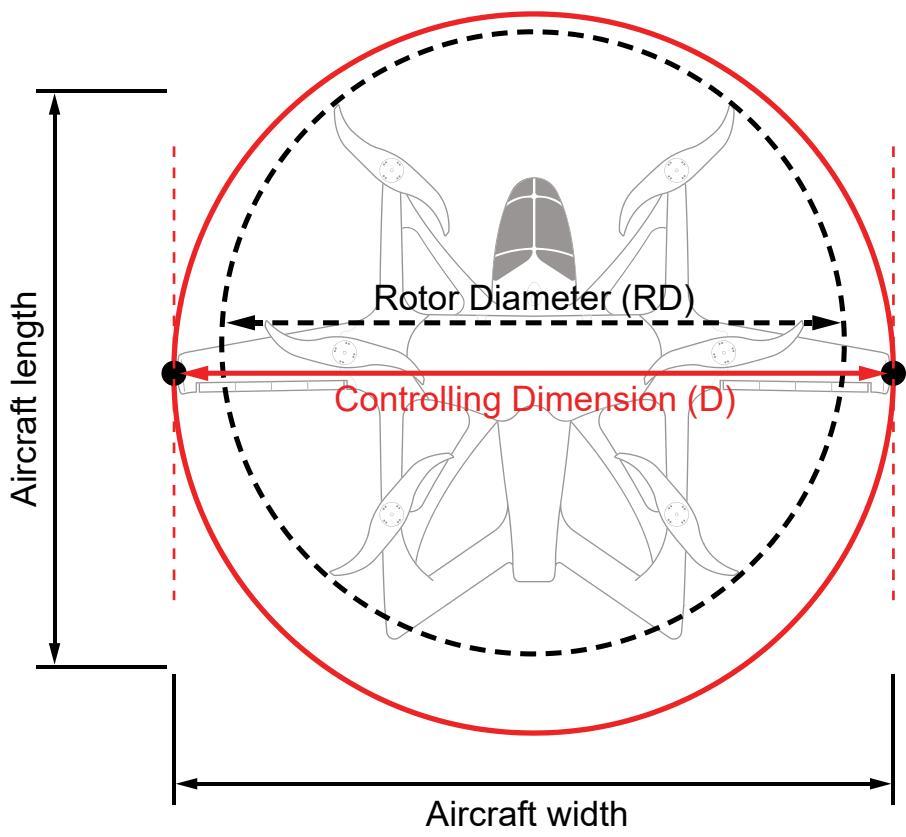
Geometry: Laid the foundation for updating the landing area geometry, creating a subset of the controlling dimension (D) related to just the propulsion devices. Where D is the diameter of the smallest circle enclosing of the entire VTOL aircraft projections, RD is the smallest circle enclosing just the propulsion units, which for some vertical takeoff and landing (VTOL) designs may be smaller than D. The geometry of the TLOF and final approach and takeoff area (FATO) are now related to the RD rather than D. The safety area has decreased in size. See paragraph 2.0.
-
Parking: Created a new section on VTOL parking with larger parking positions that support air or hover taxiing to them rather than just ground taxiing. See paragraph 3.0.
-
Downwash and Outwash Caution Area: Added a downwash/outwash caution area (DCA). Refer to the Federal Aviation Administration (FAA) Technical Center research report DOT/FAA/TC-24/42, eVTOL Downwash and Outwash Surveys, on velocity findings for example distances for aircraft 7,000 lbs (3,175 kg) and less. See paragraph 2.5.
Attachment
ENGINEERING BRIEF #105A
Vertiport Design, Supplemental Guidance to Advisory Circular 150/5390-2D, Heliport Design
I Purpose.
This Engineering Brief (EB) specifies design guidance for public and private vertiports1 , including modification of existing helicopter and airplane landing facilities, and the establishment of new sites. Vertiports are a type of heliport.
For the purposes of this EB, “General Aviation” refers to all VTOL operations other than scheduled service (with the exception of unscheduled service with VTOLs with maximum takeoff weight (MTOW) greater than 12,500 pounds (lbs)). Vertiports fall under General Aviation but are distinct from General Aviation heliports and treated separately in this EB due to their specific requirements. General Aviation vertiports may be publicly or privately owned. Advisory circular (AC) 150/5390-2, Heliport Design, was established for heliports serving helicopters with single, tandem (front and rear) or dual (side by side) rotors. EB 105A provides guidance for vertiports (a type of heliport) serving aircraft with three or more propulsive units. Specifically, for the purposes of this document, the term VTOL refers to aircraft that are being certified as powered-lift or special class rotorcraft that meet the reference aircraft criteria and characteristics in Table 1-1.
At this time, the Federal Aviation Administration (FAA) is still collecting validated VTOL aircraft operational data and is transitioning from a prescriptive approach to a performance-based design approach with the recommendations in this EB. This EB is a living document that serves as the FAA’s standards and guidance. An AC will be developed to adapt and address new aircraft and technology as performance data is received. This EB will be cancelled concurrent with the publication of the AC.
Figures in this document are general representations and are not to scale.
II Background.
The FAA has identified a need for guidance for vertiports to be utilized by VTOL aircraft.
The FAA’s previous AC on Vertiport Design, published on May 31, 1991, provided guidance for vertiport design and was based on civil tiltrotors modeled after military tiltrotor technology. However, the intended aircraft were never used commercially, and the AC was cancelled on July 28, 2010.
This EB provides the standards and guidance needed to support initial infrastructure development for VTOL operations. This guidance is correlated to the reference VTOL aircraft described in paragraph 1.5. The Reference Aircraft represents a VTOL aircraft that integrates certain design characteristics of emerging aircraft and all-engine operating performance characteristics of three currently in development and made available for testing. The Reference Aircraft has been coordinated with multiple FAA lines of business (LOBs). The Reference Aircraft is used to specify certain performance and design characteristics that informed the guidance in this EB.
There is currently limited demonstrated performance data on how VTOL aircraft operate. Research efforts are underway to better understand the performance capabilities and design characteristics of emerging VTOL aircraft. The FAA will develop a performancebased AC on vertiport design in the future, as additional performance data is gleaned about these emerging VTOL aircraft. The FAA Office of Airports is working with the FAA Aircraft Certification Service to develop a mechanism for VTOL aircraft manufacturers to demonstrate equivalent helicopter landing accuracy during their certification process.
Future guidance is expected to address more advanced operations including autonomy, facilities operating in instrument meteorological conditions (IMC), different propulsion methods, density, frequency, and complexity of landing facilities. To support the development of a comprehensive AC, additional research is required to garner VTOL aircraft performance data on downwash/outwash, failure conditions or degradation of performance, landing precision (in all azimuth wind capabilities), and nominal climb/descend/approach gradients. The data will be collected and used by the FAA research team to fill in aircraft information gaps. This will require continued coordination within the FAA across the various LOBs, as well as external collaboration with manufacturers and other stakeholders. A proponent interested in sharing data must work with the FAA Office of Airports Safety and Standards division to participate in validated empirical data collection that addresses these performance data gaps.
III Application.
This EB is intended as standards and guidance for vertiport design until a more comprehensive performance-based AC is developed. The guidance herein is not legally binding in its own right and will not be relied upon by the FAA as a separate basis for affirmative enforcement action or other administrative penalty. Conformity with this guidance, as distinct from existing statutes, regulations, and grant assurances, is voluntary only, and nonconformity will not affect existing rights and obligations. The standards and guidance contained in this EB are practices the FAA recommends establishing for an acceptable level of safety, performance, and operation in the design of new civil vertiports, and for modifications of existing helicopter and airplane landing facilities. This EB does not prescribe any guidance for the operation of a VTOL aircraft.
The vertiport design criteria in this EB is intended for special class rotorcraft and powered-lift aircraft with three or more propulsive units and a pilot on board, that fly in visual meteorological conditions (VMC), and that meet the characteristics in Table 1-1. These design recommendations are for a single aircraft using the touchdown and lift off (TLOF) area, final approach and takeoff area (FATO) area, and Safety Area at one time. The ingress and egress path should be kept clear. At all Federally-obligated facilities, the proponent is required to confirm the ingress and egress path is clear. See paragraph 2.6.
For heliport facilities that serve single, tandem (front and rear), or dual (side by side) rotor helicopters and intend to accommodate emerging VTOL aircraft, the proponent should follow the recommendations in this EB and mark the facility as a vertiport. Vertiports may accommodate helicopters that fit within the size and maximum takeoff weight (MTOW) of the design VTOL. This guidance applies to new vertiports and heliports that are modified to accept VTOL aircraft.
Proponents of vertiport facilities who intend to serve VTOL aircraft that do not meet the performance criteria and design characteristics of the Reference Aircraft included in this EB should begin coordination with the applicable FAA Regional or Airports District Office early in the planning and design process. These facilities will be subject to review on a case-by-case basis.
IV Questions.
Contact the FAA Office of Airports – Airports Safety and Standards Airport Engineering Division, AAS-100 Robert.Bassey@faa.gov for any questions about this EB.
V Effective Date.
This EB becomes effective as of the date the associated memorandum is signed by the Manager, FAA Airport Engineering Division, AAS-100.
Table of Contents
1.0 Introduction. ........ ................................................................................. 9
1.1. EB Guideline Justification. . .............................................. ..... 9
1.2. Explanation of Terms. ........ ........................................................... 9
1.3. Airspace Approval Process and Coordination. ..................................................... 12
1.4. State/Local Role. .. ............................... ..... 13
1.5. Reference Aircraft. .. .... 14
2.0 Vertiport Design and Geometry. ................................. ................ ..... 16
2.1. Overview. .... ............................................................................ ..... 16
2.2. TLOF Guidance. .... ................................................................... .... 17
2.3. FATO Guidance. ...... .......................................................................................... 21
2.4. Safety Area Guidance. ...... ............................................... ....... 23
2.5. Downwash/Outwash (DWOW) Caution Guidance. ...................................... ..... 24
2.6. VFR Approach/Departure Guidance.. ......... .... 26
3.0 Vertiport Taxiways and Parking. .... ............................................ ...... 31
3.1. Vertiport Parking. . .............................................. ..... 31
4.0 Marking, Lighting, and Visual Aids. ... ................................................ .... 33
4.1. General. . ................................................................. ...... 33
4.2. Identification Symbol... .............................................. ....... 35
4.3. TLOF Size/Weight Limitation Box. ... ........................... ...... 35
4.4. Flight Path Alignment Optional Marking and Lighting. .............................. ..... 39
4.5. Lighting. ...... ................... ....... 41
4.6. Identification Beacon. . ........................................ ..... 47
4.7. Wind Cone. . ... 47
5.0 Charging and Electric Infrastructure. ................................................................... ....... 48
5.1. Standards. .... ....................................................... ....... 48
5.2. Other Information. ..... ................................................................................ ...... 51
6.0 On-Airport Vertiports. ...... ........................... ....... 52
6.1. On-Airport Location of TLOF. ......... ...................................................... ........ 52
6.2. On-Airport Location of FATO.. ............................................ ..... 52
7.0 Site Safety Elements. . ............................................. .... 55
7.1. Fire Fighting Considerations.. ... 55
7.2. Security and Safety. . .... 55
7.3. Wind and Turbulence.. .. 56
7.4. Weather Information.. ... 57
7.5. Winter Operations. ... .... 57
7.6. Access to Vertiports by Individuals with Disabilities.. .. 57
7.7. Electromagnetic Effects. .. .... 58
Appendix A. Air Traffic Considerations for Siting Vertiports On or Near Existing
Airports ..... ... 60
A.1. Definitions...... ..... 60
A.2. Assumptions.... ..... 61
A.3. Air Traffic Considerations. . ... 61
A.4. Vertiport Siting Scenarios... .... 62
Appendix B. Acronyms and Terms ...... .... 65
Figures
Figure 1-1: Controlling Dimension. . 10
Figure 2-1: Relationship and Dimensions of TLOF, FATO, and Safety Area.... . 17
Figure 2-2. VTOL Landing Gear Loading: Gradients and Pavement . .. 20
Figure 2-3: Vertiport Gradients and Rapid Runoff Shoulder .. ... 21
Figure 2-4: DCA Caution Sign ... ... 26
Figure 2-5: VFR Vertiport Approach/Departure Surfaces.. . 28
Figure 2-6: VFR Vertiport Curved Approach/Departure and Transitional Surfaces.. .. 29
Figure 4-1: Standard Vertiport Identification Marking . ... 34
Figure 4-2: Heliport Identification Symbol .. .. 36
Figure 4-3: Form and Proportions of 36-inch (914 mm) Numbers for Marking Size and Weight
Limitations . ... 37
Figure 4-4: Form and Proportions of 18-inch (457 mm) Numbers for Marking Size and Weight
Limitations .. ... 38
Figure 4-5: Flight Path Alignment Marking and Lighting.. ... 40
Figure 4-6: TLOF/FATO Lighting .. .. 43
Figure 4-7: Elevated Vertiport Configuration Example . . 44
Figure 6-1: Example of an On-airport Vertiport. . 54
Figure 6-2: Vertiport Caution Sign. . 56
Figure 6-3. Vertiport EMI Hazard Marking . .. 58
Figure A-1. Siting Vertiports on or Near Existing Airports . ... 63
Tables
Table 1-1: Reference Aircraft .. 14
Table 2-1: Takeoff and Landing Area Minimum Dimensions . 16
Table 4-1: Perimeter Lighting Intensity and Distribution.. .. 42
Table 6-1: Recommended Minimum Distance between Vertiport FATO Center to Runway
Centerline for VFR Operations... . 53
1.0 Introduction.
1.1. EB Guideline Justification.
Limited data is available on VTOL aircraft operational characteristics, performance, maneuverability, downwash/outwash impacts, and vertiport data needs. Consequently, this EB is limited to pilot-on-board, visual flight rule (VFR) operations, and VTOL aircraft that have the characteristics and performance of the Reference Aircraft described in paragraph 1.5.
Heliports provide the most analogous present-day model for vertiports. However, there are design differences between traditional helicopters and VTOL aircraft that create specific, unique infrastructure requirements. VTOL aircraft have varied configurations including unique types and numbers of propulsion systems. As a result, the conversion ratio in AC 150/5390-2 of 0.83 × the controlling dimension (D) being used to calculate the main rotor diameter of the design helicopter is not representative of the diverse characteristics associated with the various VTOL aircraft being developed. In addition, there persists a lack of validated data on the performance capabilities of VTOL aircraft.
The anticipated Advanced Air Mobility (AAM) tempo of operations, complexity of operations, and overall number of aircraft in the National Airspace System (NAS) is expected to be high in some cases and would be influenced by local conditions in each of the operating markets. These operations are also anticipated to include commuter and ondemand (i.e., Part 135 and Part 91) operations and may require unique operational safety and infrastructure requirements similar to other types of heliports.
The FAA has begun an operational testing campaign on VTOL aircraft. Initial observations based on engagement with the aircraft that have been part of the FAA’s operational testing campaign have shown that these aircraft generally have the ability to hover out of ground effect and utilize highly augmented stability and control for operation and landing. Data gaps exist amongst the varied design configurations of these aircraft and the environmental conditions they may operate in. This ensuing EB represents a continued move toward performance-based design criteria leveraging the data collected in the FAA’s campaign. However, while valuable data has been collected, more data is needed for comprehensive performance-based design criteria.
This EB is intended for aircraft that have hover out of ground effect (HOGE) capability. If the vertiport Design VTOL aircraft is known not to perform HOGE, the sponsor should coordinate directly with the FAA to determine alternative vertiport sizing for that Design VTOL aircraft.
1.2. Explanation of Terms.
Terms used in this EB:
-
Approach/Departure Path: The approach/departure path is the flight track that VTOL aircraft follow when landing at or taking off from a vertiport. See paragraph 2.6.2.
-
Battery: One or more electrically connected cells, assembled in a single container having positive and negative terminals. A battery may include inter-cell connectors and other devices.
-
Battery pack: Two or more battery systems.
-
Battery system: Comprised of the battery, the battery charger, and any protective, monitoring, and alerting circuitry or hardware inside or outside of the battery. It also includes vents (where necessary) and packaging.
-
Controlling dimension (D): The diameter of the smallest circle enclosing the entire VTOL aircraft projection on a horizontal plane, including all possible configurations with rotors/propellers turning, if applicable. See Figure 1-1.
Figure 1-1: Controlling Dimension
-
Design VTOL aircraft: The Design VTOL aircraft is the largest VTOL aircraft with three or more propulsive units that is expected to operate at a vertiport. This Design VTOL aircraft is used to size the TLOF, FATO and Safety Area. Note that the Design VTOL aircraft is different from the Reference Aircraft used to define the performance and design criteria in this EB.
-
Downwash/Outwash (DWOW): The downward and outward movement of air caused by the action of rotating rotor blade, propeller, or ducted fan. When this air strikes the ground or some other surface, it causes a turbulent outflow of air from the aircraft.
-
Downwash/Outwash Caution Area (DCA): An operational area that is identified to protect persons and property from downwash and outwash (including jet blast or propwash) that may meet or exceed 34.5 mph (55.5 kph).
-
Elevated vertiport: A vertiport is considered elevated if it is located on a rooftop or other elevated structure where the TLOF and FATO are at least 30 inches (0.8 m) above the surrounding surface (a ground-level vertiport with the TLOF on a mound is not an elevated vertiport).
-
Effective transitional lift (ETL): The pronounced increase in translational lift during transition to forward flight due to the rotor/propeller experiencing a significantly decreased induced airflow.
-
Failure condition (FC): FC is one or more failures, which affects the aircraft’s ability to generate lift or thrust and results in a consequential state that has an impact for a given flight phase.
-
Final approach and takeoff area (FATO): The FATO is a defined area over which the aircraft completes the final phase of the approach to a hover or a landing, and from which the aircraft initiates takeoff.
-
Ground Effect: A condition of usually improved performance encountered when the aircraft is operating very close to the ground or a surface. It results from a reduction in upwash, downwash, and/or blade tip vortices, which provide a corresponding decrease in induced drag.
-
Hover: The word “hover” applies to an aircraft that is airborne and remaining in one place at a given altitude over a fixed geographical point regardless of wind.
-
Hover out of ground effect (HOGE): The ability to achieve hover without the benefit of the ground or a surface.
-
Imaginary surface(s): The imaginary planes defined in Title 14 Code of Federal Regulations (CFR) Part 77, Safe, Efficient Use, and Preservation of the Navigable Airspace, centered about the FATO and the approach/departure paths, which are used to identify the objects where notice to and evaluation by the FAA is required.
-
Obstruction to air navigation: Any fixed or mobile object, including a parked aircraft, of greater height than any of the heights or imaginary surfaces presented in subpart C of 14 CFR Part 77, Safe, Efficient Use, and Preservation of the Navigable Airspace.
-
Powered-lift: Defined in 14 CFR Part 1 as a heavier-than-air aircraft capable of vertical takeoff, vertical landing, and low speed flight that depends principally on engine-driven lift devices or engine thrust for lift during these flight regimes and on nonrotating airfoil(s) for lift during horizontal flight.
-
Reference Aircraft: The Reference Aircraft represents a VTOL aircraft that integrates certain design characteristics of emerging aircraft currently in development and performance characteristics of three currently in development and made available for testing. The Reference Aircraft is used to specify certain performance and design characteristics that informed the vertiport design guidance in this EB.
-
Rotor Diameter (RD): The largest length of all the rotors from tip to tip. It can be computed by finding the diameter of the smallest circle enclosing all the lift producing propulsion units, including their propellers, rotors, fans, etc., on a horizontal plane, while the aircraft is in the vertical takeoff or landing configuration, with rotors/propellers/fans turning, if applicable. The RD must also incorporate all landing gear and surface touch points. See Figure 1-1.
-
Safety Area: The Safety Area is a defined area surrounding the FATO intended to reduce the risk of damage to aircraft accidentally diverging from the FATO.
-
Translational Lift: Translational lift is the improved rotor/propeller efficiency resulting from directional flight.
-
Touchdown and liftoff area (TLOF): The TLOF is a load-bearing, generally paved, area centered in the FATO on which the aircraft performs a touchdown or liftoff.
-
Vertiport: An area of land, water, or a structure used, or intended to be used, to support the landing, takeoff, taxiing, parking, and storage of powered-lift aircraft or other aircraft that vertiport design and performance standards established by the Administrator can accommodate.†
-
Vertiport elevation: The highest elevation of all usable TLOFs within the vertiport expressed in feet above mean sea level (MSL).
1.3. Airspace Approval Process and Coordination.
For vertiport development on federally obligated airports, the infrastructure or equipment must be depicted on the Airport Layout Plan (ALP). See AC 150/5070-6, Airport Master Plans. For vertiport development on airports or heliports identified under § 77.9(d), at least 45 days before the start date of the proposed construction or alteration or the date an application for a construction permit is filed (whichever is earliest), a sponsor must submit a Form 7460-1, Notice of Proposed Construction or Alteration, and obtain a nonobjectionable airspace determination. The FAA’s review of the ALP and airspace determination must be completed prior to the start of construction.
For development on non-federally obligated airports or heliports or for non-federally funded standalone vertiport sites, and in compliance with 14 CFR Part 157, Notice of Construction, Alteration, Activation, and Deactivation of Airports, the proponent must submit FAA Form 7480-1, Notice for Construction, Alteration and Deactivation of Airports, at least 90 days in advance of the day that construction work is to begin on the takeoff and landing facility (see § 157.5 for other scenarios). Note: Airspace determination is not tied to this 90-day advance notice. Given the nascence of the AAM industry, the FAA highly encourages that engagement with the appropriate FAA regional or district office begin before the submission of the Form 7480-1, but an FAA evaluation is predicated on the submitted Form 7480-1.
For non-federally funded heliport facilities that are being modified in geometry in accordance with the design criteria in this EB, the sponsor must submit a new Form
7480-1 at least 90 days in advance of the day that work is to begin. See 14 CFR Part 157. The Form 7480-1 can be submitted electronically as a Digital 7480 at https://adip.faa.gov. The FAA’s Flight Standards Service Office will determine when to do an onsite evaluation using risk-based analysis (see FAA Order 8900.1, Flight Standards Information Management System).
1.4. State/Local Role.
Many state departments of transportation, aeronautics commissions, or similar authorities require prior approval and, in some instances, a license or permit to establish and operate landing facilities. Those seeking to establish a vertiport should first contact their
respective state or local transportation or aeronautics departments or commissions for specifics on applicable licensing or permitting. Several states also administer Federal assistance programs and may be staffed to provide technical advice. Municipalities often staff a help desk to provide assistance on navigating local permitting processes. Contact information for state aviation agencies is available at
https://www.faa.gov/airports/resources/state_aviation/. State agencies may also choose to educate local officials throughout their state and advocate for the harmonization of applicable local policies.
In addition to state requirements, many local communities have enacted zoning ordinances, building and fire codes, and various land entitlement processes that guide development approval and operation, such as conditional use permits. Some communities have developed codes or ordinances regulating environmental issues such as noise and air pollution. Therefore, communities, proponents, or sponsors seeking to establish a publicor private-use vertiport should make early contact with:
• local officials or agencies representing the local land use/zoning board;
• the fire, police, or sheriff's department; and
• stakeholders who represent the area where the vertiport is to be located.
For optimal success, the FAA encourages early and continued engagement across all project phases. This can help identify and mitigate potential conflicts, ensuring smoother project approvals.
State regulators, departments of transportation, and local communities can also use the guidance and best practices outlined in this EB when reviewing a proposed vertiport facility or developing independent standards.
In addition to state and local coordination, vertiport proponents are encouraged to coordinate potential sites with any nearby landing facilities and aviation stakeholders. Lack of early coordination can cause airspace, operational, safety, capacity, and financial impacts. While the FAA will review all new vertiport proposals for the safe and efficient utilization of navigable airspace by aircraft and the safety of persons and property on the ground, early coordination with these entities may offer early insights into airspace and capacity conflicts before investments are made.
1.5. Reference Aircraft.
The Reference Aircraft integrates the design characteristics of many emerging VTOL aircraft and the performance characteristics of three currently in development. The Reference Aircraft is used to specify certain performance and design characteristics that informed the vertiport design in this EB.
Emerging VTOL aircraft models are evolving rapidly with OEMs approaching aircraft certification from a wide range of different designs. While aircraft classifications are useful in takeoff and landing area design and airspace analysis, new VTOL aircraft concepts vary significantly in terms of design, aircraft dimensions, performance, and operational characteristics. Furthermore, these new VTOL aircraft do not have an established operating history and have not yet received FAA airworthiness certification. However, OEM engagement has revealed some common characteristics among VTOL aircraft prototypes including multiple propulsion systems, HOGE capability, and highly augmented stability and control.
The vertiport design guidance in this EB relies on design characteristics and performance capabilities of preproduction aircraft until there is adequate research on these emerging aircraft to develop a performance-based AC. Accordingly, the aircraft features and performance capabilities listed in Table 1-1 create a Reference Aircraft to inform this EB. The design characteristics, performance, and operating conditions that make up the reference VTOL aircraft will be reviewed in the future as the FAA continues to engage with emerging VTOL aircraft manufacturers.
Table 1-1: Reference Aircraft
| Design Characteristics | Criteria |
| Propulsion | Electric battery driven, utilizing distributed electric propulsion |
| Propulsive units | 3 or more |
| Battery systems | 2 or more |
| MTOW | 12,500 1bs (5,670 kg) or less |
| Controlling Dimension (CD) | 50 feet (15.2 m) or less |
| Flight Control | Highly augmented stability and control |
| Operating Conditions | |
| Criteria Land-based (ground or elevated) – no amphibian or float | |
| Operation location | operations |
| Pilot | On board |
| Flight conditions | VMC |
| Performance | Criteria |
| Hover | Hover out of ground effect (HOGE) in normal operations |
| Takeoff | Vertical |
| Landing | Vertical from a steady state hover |
2.0 Vertiport Design and Geometry.
2.1. Overview.
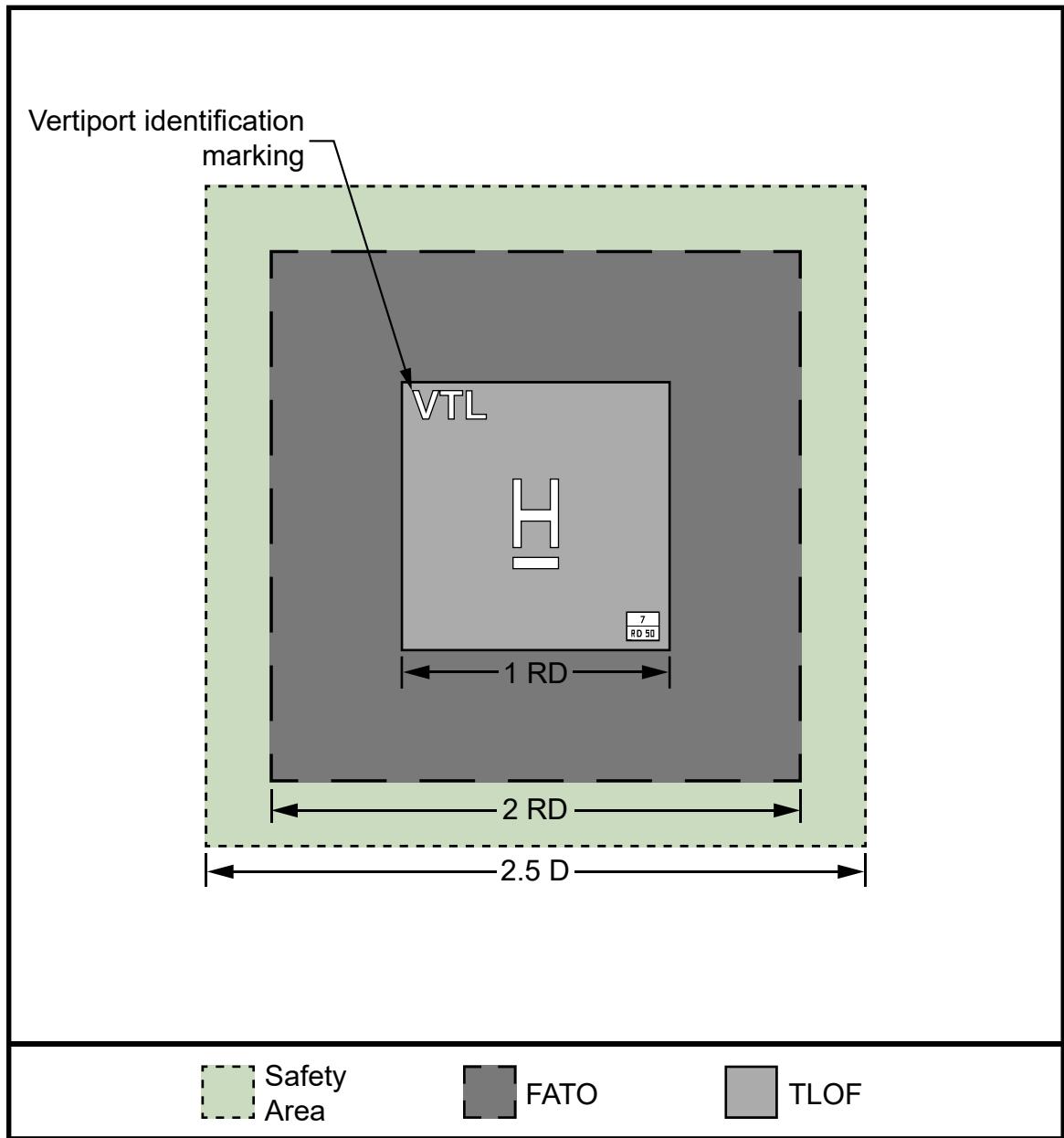
The takeoff and landing area design and geometry contained in this EB includes the TLOF, the FATO, and the Safety Area. The dimensions for these areas are presented in Table 2-1 and are based on the dimension D or RD of the Design VTOL aircraft as defined for each vertiport facility (see Figure 1-1). The FAA Office of Airports is working with the FAA Aircraft Certification Service to develop a mechanism and target for aircraft developers to, as an option, demonstrate landing accuracy. The ability to demonstrate equivalent helicopter landing accuracy to this target will support a reduced non-load-bearing FATO and, at a minimum, a 1 RD TLOF infrastructure requirement. ‡ The sizing requirements contained in Table 2-1 will continue to be applied at landing facilities catering to aircraft that do not or cannot demonstrate the target landing accuracy during type certification. A future performance-based TLOF size will incorporate the aircraft observed landing precision, while ensuring all propulsors can remain over a loadbearing surface. These sizing requirements may be modified as additional VTOL operational testing is performed. See Figure 2-1 for the relationship among the TLOF, FATO, and Safety Area.
Table 2-1: Takeoff and Landing Area Minimum Dimensions
| Element | Dimension(length and width or diameter) |
| TLOF | 1RD |
| FATO | 2RD |
| Safety Area | 2.5D |
Figure 2-1: Relationship and Dimensions of TLOF, FATO, and Safety Area
2.2. TLOF Guidance.
The TLOF is a load-bearing, generally paved, area centered in the FATO on which the VTOL aircraft performs a touchdown or liftoff. The following guidelines apply to the TLOF:
-
Located at ground level, on elevated structures§ , or at rooftop level.
-
On level terrain or a level structure.
-
Clear of penetrations and obstructions to the transitional surfaces.
-
Load-bearing (static and dynamic for Design VTOL aircraft). See Figure 2-2.
a. Supports the static load of the Design VTOL aircraft and/or any ground support vehicles, whichever is more demanding for pavement design. The static loads are equal to the aircraft’s maximum takeoff weight applied through the total contact area of the landing gear.
b. Supports the dynamic loads based on 150 percent of the maximum takeoff weight of the Design VTOL aircraft. For design purposes, assume the dynamic load at 150 percent of the maximum takeoff weight applied over the whole landing gear for a landing gear with wheels, and at the single point of contact for a landing gear with skids.
c. Accounts for rotor/propeller downwash load in load-bearing capacity.
-
Centered within its own FATO and Safety Area.
-
Circular, square, or rectangular in shape**. The TLOF should have the same shape as the FATO and Safety Area. A FATO and Safety Area can be rectangular with square TLOF.
-
Opposing sides of the FATO and Safety Area are equidistant to the center of the TLOF.
-
Minimum length and width (or diameter for circular) as outlined in Table 2-1.
-
Meets general surface characteristics and pavement guidelines including the following:
a. Has a paved or aggregate-turf surface (see AC 150/5370-10, Standard Specifications for Construction of Airports, Items P-217, Aggregate-Turf Runway/Taxiway, and P-501, Cement Concrete Pavement).
b. Use Portland cement concrete (PCC) when feasible for ground-level facilities. An asphalt surface is less desirable for VTOLs as it may rut under the wheels or skids of a stationary VTOL. This has been a factor in some rollover accidents. In addition, sections of asphalt have also been known to adhere to skids only to fall off after takeoff creating a hazard to vehicles, buildings, and persons on the ground.
c. Has a roughened pavement finish (e.g., brushed or broomed concrete) to provide a skid-resistant surface for VTOL aircraft and a non-slippery footing for people.
d. Elevations between any paved and unpaved portions of the TLOF and FATO are equal.
e. Surface is stabilized to prevent erosion or damage from rotor/propeller downwash or outwash from VTOL aircraft operations. (Find guidance on pavement design and soil stabilization in AC 150/5320-6, Airport Pavement Design and Evaluation, and AC 150/5370-10.)
f. Preferred surface of elevated TLOFs is concrete. Preferred material for elevated structures is metal or coated metal with an approved coating. If the surface is conductive, it may need to be insulated and/or grounded to the extent feasible to eliminate the threat of conducting electricity in cases of a short circuit or lightning strike. If the surface is metal, it should be grounded. Insulation is permissible if grounding is not feasible. Construct rooftop and other elevated TLOFs of metal, concrete, or other materials subject to local building codes.
g. Elevated TLOFs comply with 29 CFR § 1926.34, Means of Egress, and 29 CFR § 1910.25, Stairways, as applicable. See National Fire Protection Association (NFPA) 418, Standard for Heliport and Vertiports.
-
Gradient provides positive drainage (between -0.5 and -2.0 percent) off of and away from the pavement, as shown in Figure 2-3. If gradient cannot be met, and edge drains are used, then drainage systems should meet NFPA 415, Standard on Airport Terminal Buildings, Fueling Ramp Drainage, and Loading Walkways, requirements.
-
For rooftop or other elevated TLOFs, ensure that:
a. The FATO and TLOF are at or above the elevation of the adjacent Safety Area.
b. Elevator penthouses, cooling towers, exhaust vents, fresh-air vents, and other elevated features or structures do not affect VTOL aircraft operations or penetrate the TLOF, FATO, Safety Area, approach surface, or transition surface.
c. Fresh air vents for any attached building are not impacted by landing facility operations.
d. See paragraph 7.3, Wind and Turbulence.
Figure 2-2. VTOL Landing Gear Loading: Gradients and Pavement
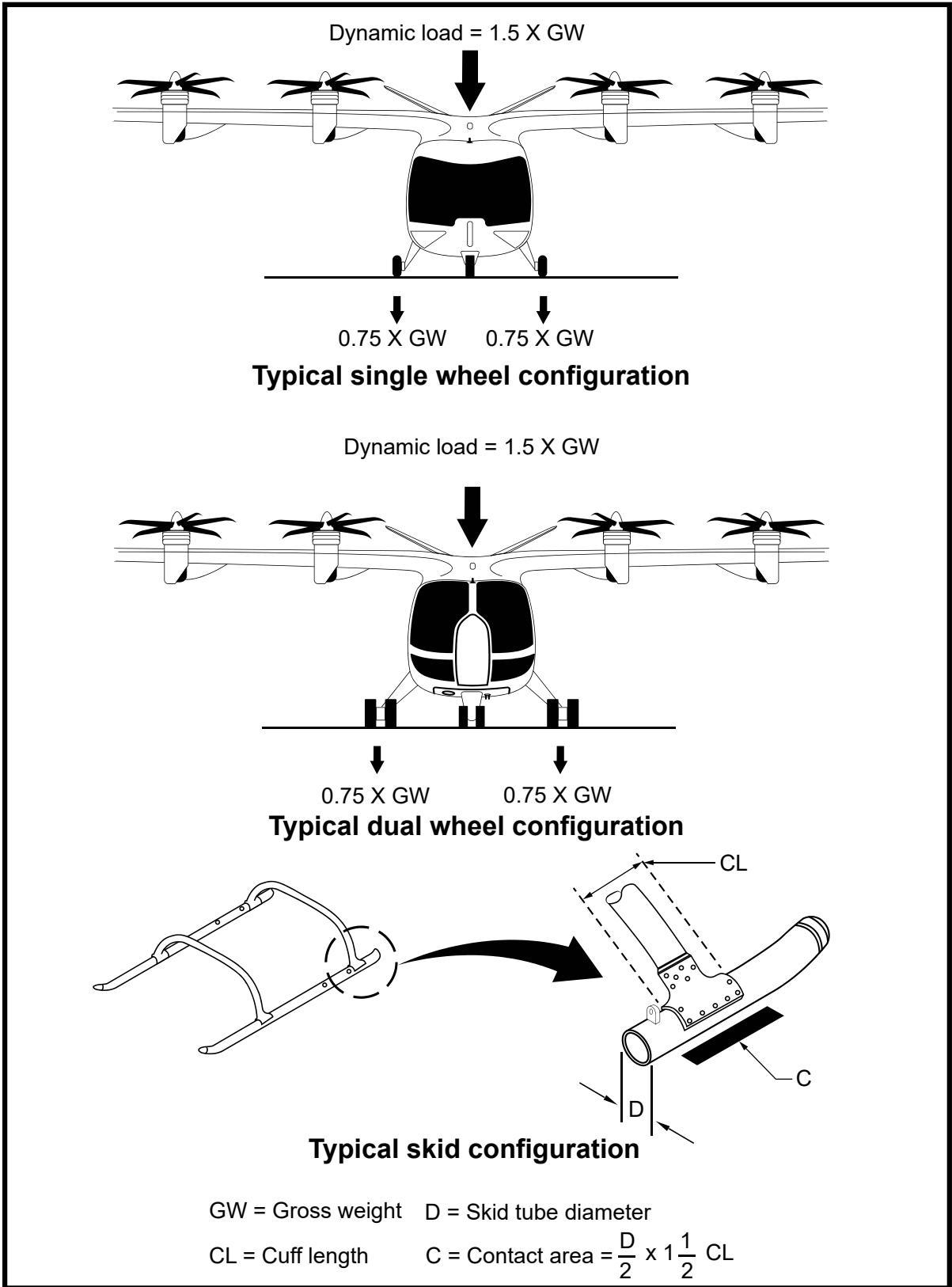
Figure 2-3: Vertiport Gradients and Rapid Runoff Shoulder
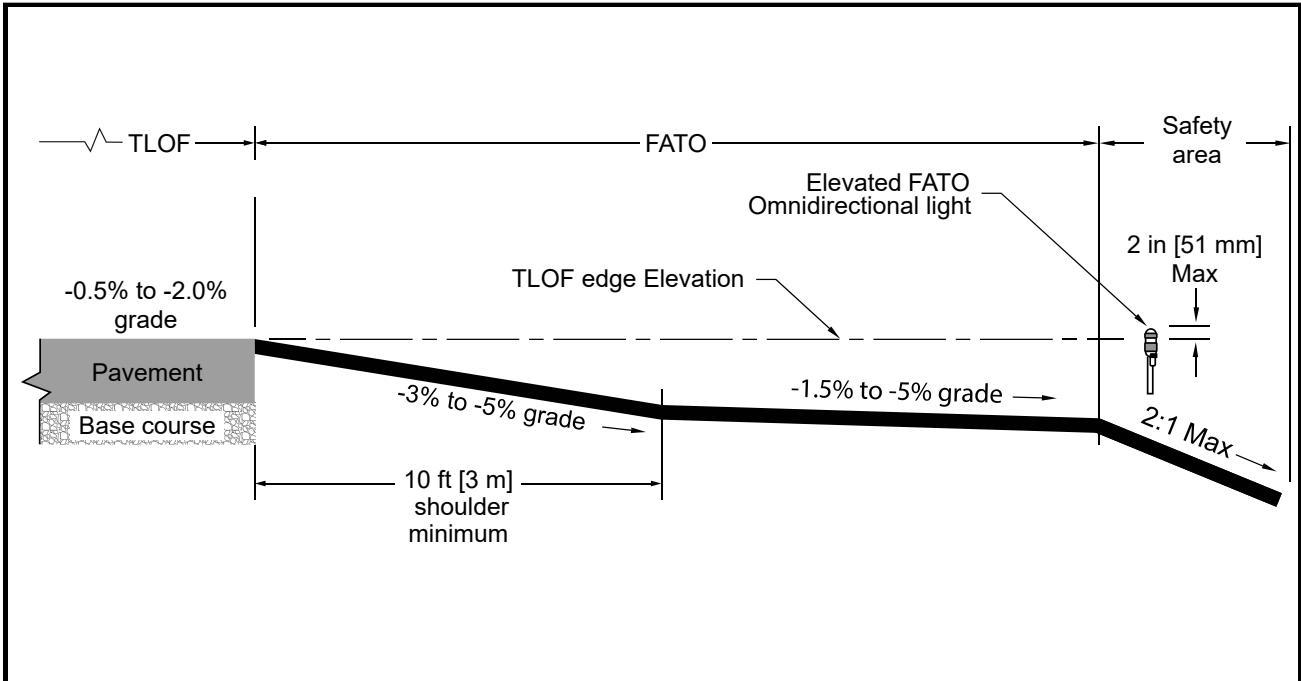
The slope direction is based on the topography of the site.
Grade the TLOF, FATO, and Safety Area to provide positive drainage of the entire area for the TLOF, FATO, and Safety Area.
2:1 maximum Safety Area gradient for vertiports at ground level or where applicable at elevated structures.
2.3. FATO Guidance.
The FATO is a defined area over which the VTOL aircraft completes the final phase of the approach to a hover or a landing and from which the aircraft initiates takeoff. The following guidelines apply to the FATO:
-
Located at ground level, on elevated structures, or at rooftop level.
-
Clear with no penetrations or obstructions except for navigational aids that are fixedby-function (e.g., flight path alignment marking and lighting, approach lighting, TLOF lights)†† which should be of the lowest mass practicable and frangiblymounted objects no higher than 2 inches (51 mm) above the adjacent TLOF elevation, to the extent practicable. See AC 150/5220-23, Frangible Connections.
-
Load-bearing (static and dynamic for Design VTOL aircraft), including the following features:
a. Supports the static loads of the Design VTOL aircraft and/or any ground support vehicles, whichever is more demanding for pavement design. The static loads are equal to the aircraft’s maximum takeoff weight applied through the total contact area of the landing gear.
b. Supports the dynamic loads based on 150 percent of the maximum takeoff weight of the Design VTOL aircraft. For design purposes, assume the dynamic load at 150 percent of the maximum takeoff weight applied over the whole landing gear for a landing gear with wheels, and at the single point of contact for a landing gear with skids.
c. Downwash load is accounted for in load-bearing capacity.
-
Centered within its own Safety Area.
-
Minimum length and width (or diameter for circular) as outlined in Table 2-1.
-
The same geometric shape as the $\mathrm { T L O F ^ { \ddagger } }$ and Safety Area, except that the FATO and Safety Area can be rectangular with a square TLOF.
-
Design the distance between the opposing sides of the TLOF, FATO and Safety Area perimeters to be equidistant to the TLOF.
-
Meets general surface characteristics and pavement guidelines including the following:
a. Paved or aggregate-turf surface (see AC 150/5370-10, Items P-217, Aggregate-Turf Pavement and P-501, Cement Concrete Pavement).
b. Use Portland cement concrete (PCC) when feasible for ground-level facilities. An asphalt surface is less desirable for VTOLs as it may rut under the wheels or skids of a stationary VTOL. This has been a factor in some rollover accidents. In addition, sections of asphalt have also been known to adhere to skids only to fall off after takeoff creating a hazard to vehicles, buildings, and persons on the ground.
c. Has a roughened pavement finish (e.g., brushed or broomed concrete) to provide a skid-resistant surface for VTOL aircraft and a non-slippery footing for people.
d. Elevations between any paved and unpaved portions of the FATO are equal.
e. Surface is stabilized to prevent erosion of damage from rotor/propeller downwash or outwash from VTOL aircraft operations. (Find guidance on pavement design and soil stabilization in AC 150/5320-6 and AC 150/5370-10.)
f. Preferred surface of elevated FATO is concrete. If the surface is metal, it must be insulated/grounded to the extent feasible to eliminate the threat of conducting electricity in the case of a short circuit or lightning strike.
g. Elevated FATOs should be metal or concrete and comply with 29 CFR § 1926.34 and 29 CFR § 1910.25, as applicable.
-
The FATO surface prevents loose stones and any other flying debris caused by rotor/propeller downwash or outwash.
-
Gradient provides positive drainage (between 1.5 and 5.0 percent) off of and away from the pavement, with a minimum 10-foot wide (3 m wide) rapid runoff shoulder sloped between 3.0 and 5.0 percent, as shown in Figure 2-3. Design a negative gradient of not more than 2 percent in any areas where a VTOL is expected to land. If gradient cannot be met, and edge drains are used, then drainage systems should meet NFPA 415 requirements.
-
The edge of the FATO abutting the TLOF is the same elevation as the TLOF.
-
If the FATO is located on a rooftop or other elevated structures, ensure that:
a. The FATO and TLOF elevations are at or above the elevation of the adjacent Safety Areas.
b. The FATO is above the level of any obstacle in the Safety Area that cannot be removed.
c. Title 29 CFR § 1910.28, Duty to Have Fall Protection and Falling Object Protection, requires that the provision of fall protection if the platform is elevated 4 feet (1.2 m) or more above its surroundings. The FAA recommends such protection for all platforms elevated 30 inches (0.8 m) or more.
d. Does not use permanent railings or fences that would be safety hazards, such as those obstructing or penetrating an imaginary surface, during aircraft operations.
e. Safety nets that meet state and local regulations, are at least 5 feet (1.5 m) wide, and meet the following criteria can be used as one potential solution to protect against falls and falling objects:
i. The insides and outside edges of the nets are fastened to a solid structure.
ii. The net is constructed of materials that are resistant to environmental effects and is inspected annually for integrity.
iii. The net has a load carrying capability of 25 lbs per square foot (122 kg/sq m).
iv. The net is located at or below the edge elevation of the FATO.
v. The net is attached to the outer perimeter frame of the FATO.
2.4. Safety Area Guidance.
The Safety Area is a defined area surrounding the FATO intended to reduce the risk of damage to VTOL aircraft unintentionally diverging from the FATO. The following guidelines apply to the Safety Area:
-
Located at ground level, on elevated structures, at rooftop level, and can extend over water or in clear airspace.
-
Clear with no penetrations or obstructions except for navigational aids that are fixedby-function§§, which must be on frangible mounts. See AC 150/5220-23. Note: See paragraph 2.3.
-
For elevated TLOFs, no fixed objects within the Safety Area project above the FATO except those fixed-by-function which must be on frangible mounts. See AC 150/5220-23. Note: See paragraph 2.3.
-
Minimum length and width (or diameter for circular) as outlined in Table 2-1.
-
The same geometric shape as the TLOF and FATO, except a FATO and Safety Area can be rectangular with a square TLOF.
-
Design the distance between the opposing sides of the TLOF, FATO and Safety Area perimeters to be equidistant regardless of the shape of the TLOF.
-
If at ground level, the surface prevents loose stones and any other flying debris caused by downwash or outwash.
-
If at ground level, gradient provides positive drainage away from the FATO no steeper than 2:1, horizontal units and vertical units, respectively. See Figure 2-3.
-
On rooftop or other elevated FATOs, meets requirements contained in Title 29 CFR § 1910.28.
2.5. Downwash/Outwash (DWOW) Caution Guidance.
Downwash is the airflow created by the propulsion units producing lift in vertical flight. When the downwash hits the ground, it moves horizontally as outwash. The downwash and outwash created from the propulsion units of VTOL aircraft can be dangerous to people, property, equipment, and other aircraft. This downward and outward flow can result in ground surface erosion, wake recirculation, foreign object debris (FOD) and wind hazards.
Air velocities of approximately 34.5 mph (55.5 kph) or greater can impact vertiport safety***. For vertiport planning purposes, DCAs should be established anywhere that wind velocity can potentially meet or exceed 34.5 mph (55.5 kph). These DCAs should be established in the form of operational boundaries, or areas of restriction/control on movement of persons during VTOL operations. The DCA should be in effect during any VTOL operations creating DWOW. The DCA may be a different size depending on the aircraft operating at the time. Vertiport operators should utilize the largest DCA size for the aircraft operating at the facility to determine distances used in the design considerations, signage, or movement restrictions. Vertiport development, landscaping, and other facility elements located inside the DCA should be designed and managed to mitigate objects that can become FOD or projectiles.
Through research, the FAA has identified the need for the DCA to extend beyond the safety area. Given research findings, the FAA William J. Hughes Technical Center is continuing to collect data and will update research report DOT/FAA/TC-24/42, eVTOL Downwash and Outwash Surveys, as wind velocities at various distances become available for aircraft 7,000 lbs (3,175 kg) or less.††† For heavier aircraft, the proponent will need to work directly with the FAA to determine appropriate sizing for the DCA.
The design of the DCA should consider that, in addition to the hover-over-the-landing point, DWOW will be prevalent whenever the VTOL is operating, including while taxiing and in parking areas. The combined risk from an aviation safety and occupational health and safety perspective may require supervision of vehicular and pedestrian traffic during VTOL movements, provision of robust maintenance and FOD prevention processes, and safeguarding of the DCA from future development to reduce the likelihood of injury or third-party damage. See Figure 2-4.
The as-built environment around the vertiport should be considered when establishing the DCA because certain types of structures may result in narrow venturi effect channels where the DWOW velocity is increased. Even moveable objects like parked vehicles can cause these venturi effect channels.
The primary way to mitigate the risks of DWOW to bystanders is to physically prohibit them from entering the DCA while it is in effect. The DCA can extend beyond the boundaries of the vertiport itself, and appropriate measures should be taken to mitigate the risks of DWOW in these areas. However, these measures must not become obstacles or promote the undesired venturi effect, which may increase risk to both bystanders and aircraft. Winds recirculating back to the aircraft can impact control inputs, particularly during critical phases of flight, and structures near the TLOF can create turbulence patterns that may not be reflected by wind cones. This can be either of a wall type – ideally with an upwards deflective curve on the inside to allow outwash to dissipate rather than recirculate back to the aircraft – or alternative methods such as slat structures / blast screens may be used, which are especially helpful for walkways in the vicinity of the vertiport.
CAUTION
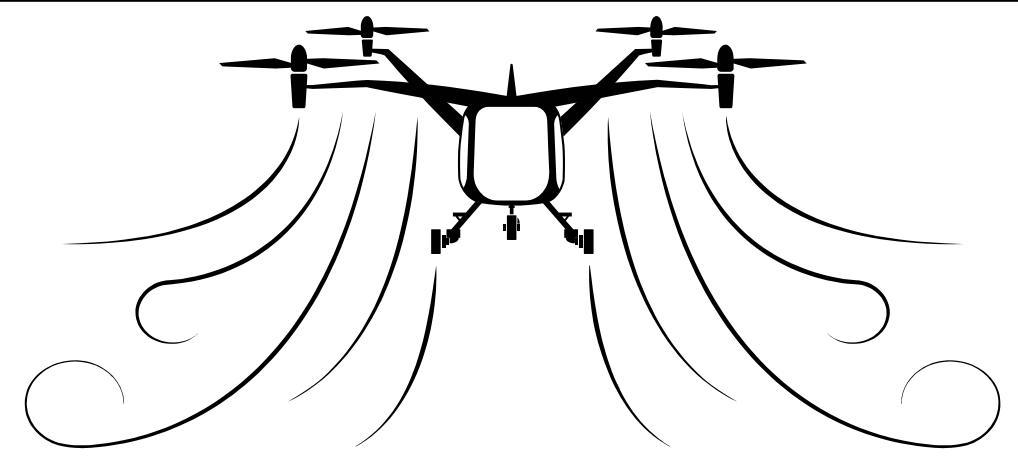
Strong Winds Strong winds may occur while aircraft are operating
2.6. VFR Approach/Departure Guidance.
2.6.1. VFR Approach/Departure and Transitional Surfaces.
The imaginary surfaces defined in 14 CFR Part 77, Safe, Efficient Use, and Preservation of the Navigable Airspace, for heliports are applicable to vertiports and include the primary surface, approach, and transitional surfaces. Part 77 establishes standards and notification requirements for objects affecting navigable airspace. This notification provides the basis for:
evaluating the effect of construction or alteration on aeronautical operating procedures;
• determining the potential hazardous effect of proposed construction on air navigation;
• identifying mitigating measures to enhance safe air navigation; and
aeronautical charting for new objects.
The following applies to these imaginary surfaces:
-
The primary surface is synonymous with the FATO. This surface is a horizontal plane at the elevation of the established vertiport elevation.
-
The approach surface (and, by reciprocal, the departure surface) begins at the edge of the FATO (vertiport primary surface) with the same width as the primary surface and extends outward and upward for a horizontal distance of 4,000 feet (1,219 m) where its width is 500 feet (152 m). The slope of the approach surface is 8:1, horizontal units and vertical units, respectively.
-
The transitional surfaces extend outward and upward from the lateral boundaries of the primary surface and from the approach surfaces at a slope of 2:1, horizontal units and vertical units, respectively, for 250 feet (76 m) measured horizontally from the centerline of the primary and approach surfaces.
-
The approach, transitional, and primary surfaces should be clear of penetrations (with the exception of navigational aids that are fixed by function) unless an FAA aeronautical study determines penetrations to any of these surfaces not to be hazards. See Part 77.9(d) to determine when notification is required to initiate when aeronautical studies are conducted.
Figure 2-5 and Figure 2-6 show these surfaces for straight-in and curved approaches, respectively.
Figure 2-5: VFR Vertiport Approach/Departure Surfaces
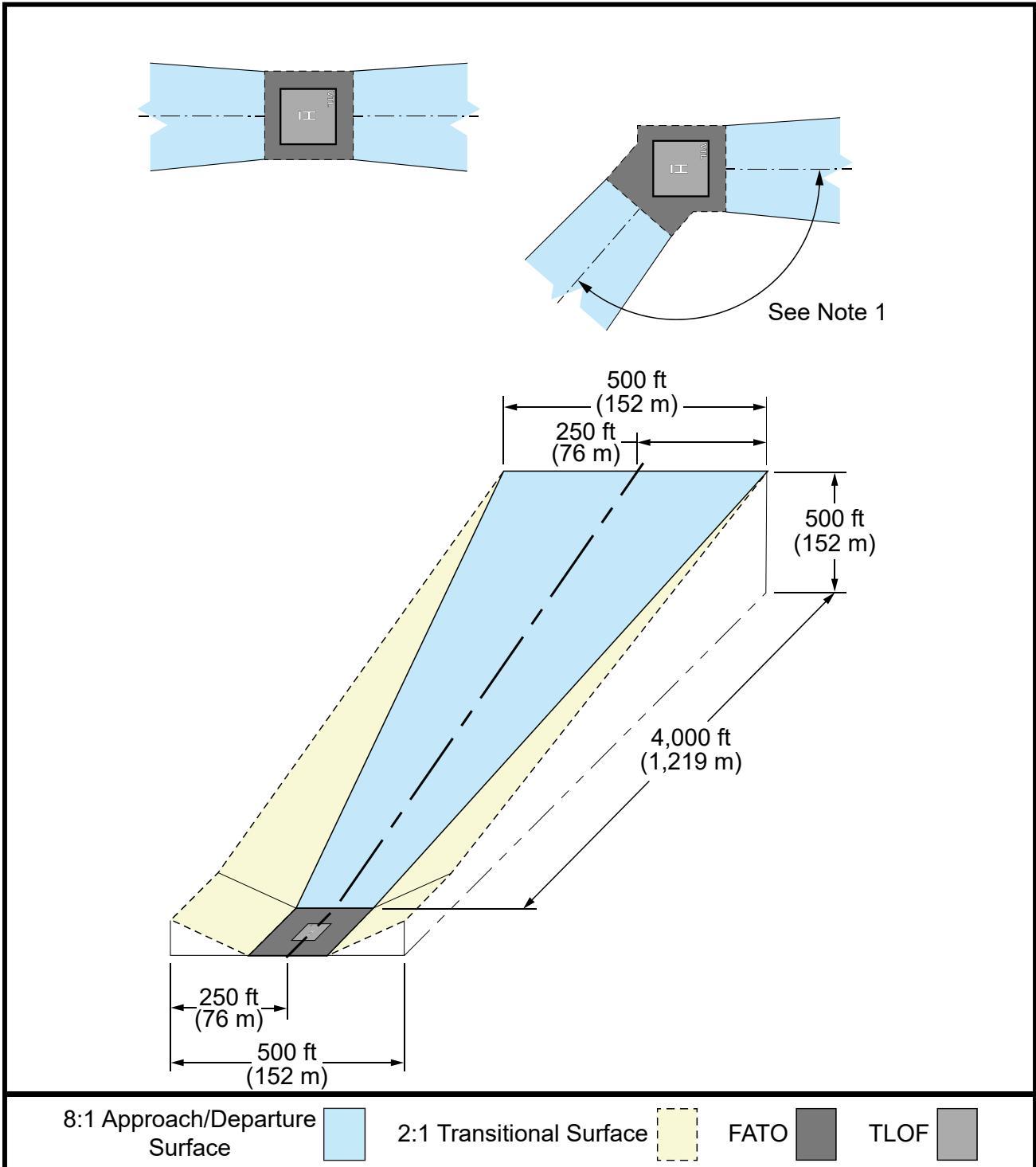
The preferred approach/departure surface is based on the predominant wind direction. Where a reciprocal approach/departure surface is not possible in the opposite direction, use a minimum 135-degree angle between the two surfaces.
Figure 2-6: VFR Vertiport Curved Approach/Departure and Transitional Surfaces
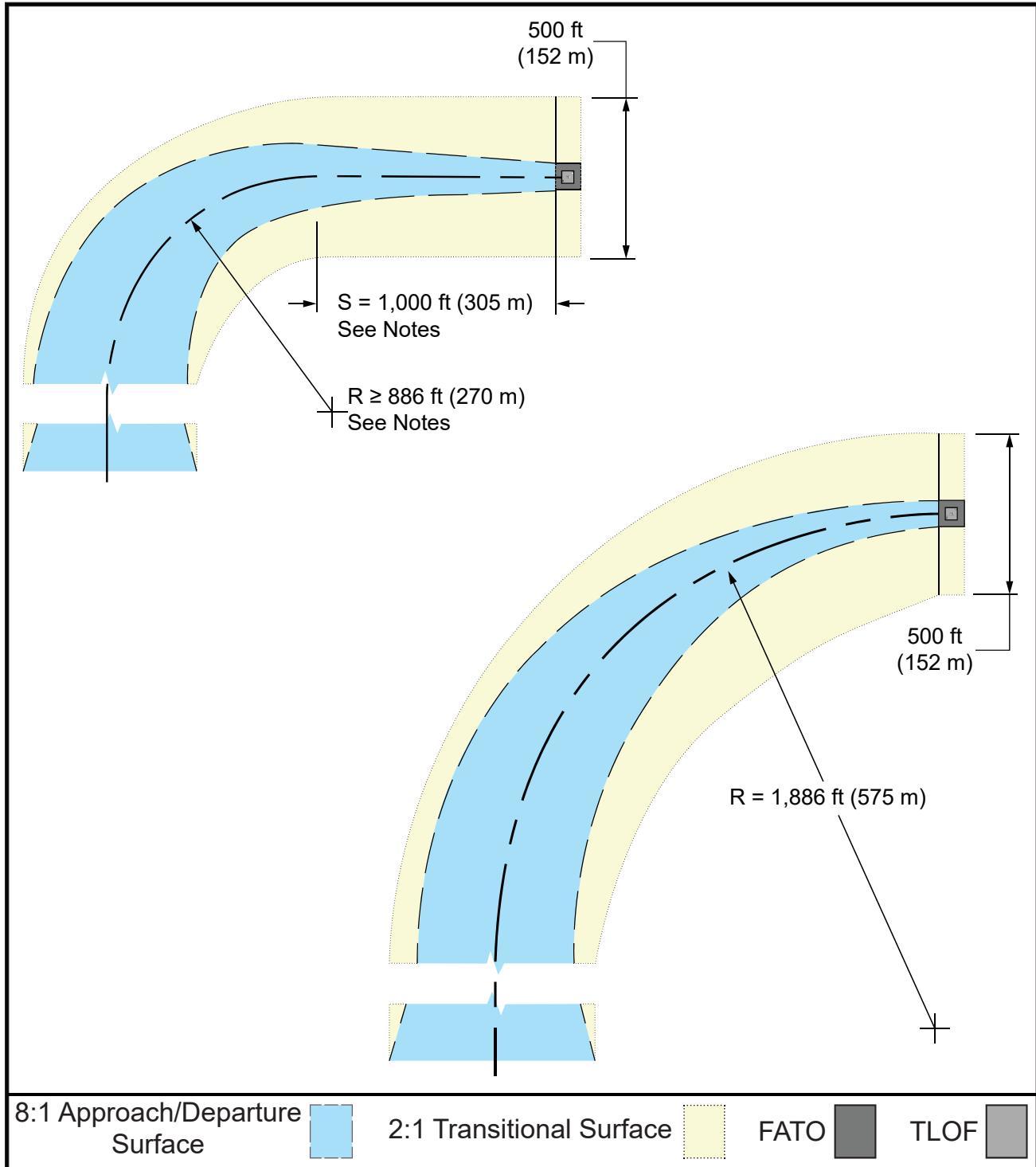
Use any combination of straight portions of one curved portion using the following formula: S + R ≥ 1,886 ft (575 m) and R ≥ 886 ft (270 m), where S is the length of the straight portion(s) and R is the radius of the turn. Note that any combination ≥ 1,886 ft (575 m) will work.
The minimum total length of the centerline of the straight and curved portion is 4,000 ft (1,219 m).
VTOL takeoff performance may be reduced in a curve. Consider a straight portion along the takeoff climb surface prior to the start of the curve to allow for acceleration.
2.6.2. VFR Approach/Departure Path.
The approach/departure path is the flight track that VTOL aircraft follow when landing at or taking off from a vertiport. The following guidelines apply to the approach/departure path(s):
-
Preferred approach/departure paths are aligned with the predominant wind direction as much as possible, to avoid downwind operations and keep crosswind operations to a minimum.
-
More than one approach/departure path is provided. They should be reciprocal in magnetic heading or at least 135 degrees apart.
-
Additional approach/departure paths are based on an assessment of the prevailing winds or separated from the preferred flight path by at least but not limited to 135 degrees.
-
All approach and departure paths are free of obstructions.
-
The approach/departure paths must assure 8:1 horizontal units and vertical units.
-
To the extent practicable, design vertiport approach/departure paths to be independent of approaches to, and departures from, active runways if separate vertiport takeoff and landing areas are needed.
-
The approach and departure path may be curved but only the VFR approach/departure and transitional surfaces outlined in paragraph 2.6.1 are addressed in 14 CFR Part 77, Safe, Efficient Use and Preservation of the Navigable Airspace. Therefore, while they may be used, curved approaches are not evaluated by the FAA for the effect of objects (temporary or permanent, existing or new) on aeronautical operating procedures. These curved approaches are also not considered in aeronautical charting for new objects.
See Figure 2-4 for a visual depiction of this guidance.
3.0 Vertiport Taxiways and Parking.
Further research is needed to understand VTOL taxiing and parking needs. In future guidance, taxiway guidance will be included. If necessary, in the interim, vertiports designed for ground taxiing can follow AC 150/5300-13 Taxiway Guidelines for Group 1 aircraft. For hover/air taxi, vertiport design should follow taxiway guidance in AC 150/5390-2 for the General Aviation type and include a DCA as described in paragraph 2.5. Consider VTOL turn radius when designing taxi intersections and parking for wheeled VTOLs. When designing parking positions, consider safety and fire mitigation measures for charging operations (see paragraph 5.0).
3.1. Vertiport Parking.
If more than one VTOL at a time is expected at a vertiport, design the facility with an area specifically designated for parking multiple VTOLs. The size of this area depends on the number and size of specific VTOLs to be accommodated. It is not necessary that every parking position accommodate the Design VTOL. Design the individual parking positions to accommodate the VTOL sizes and weights expected to use the parking position at the facility. Use the largest VTOL expected to use a parking position to determine the separation between parking positions intended for VTOL of different sizes.
Use the Design VTOL to determine the separation between parking positions and taxiways/taxilanes when using AC 150/5300-13. Use the Design VTOL to determine the separation between parking positions and taxi routes when using AC 150/5390-2. If the parking area is designed as one large apron, use the nearest parking position to determine separation distance.
-
Design the parking positions to support the static loads of the VTOL intended to use the parking area.
-
For parking positions that will allow hover and/or air taxi operations, the parking position should be no smaller than the FATO size and meet dynamic FATO loadbearing requirements. Ground vehicle loads should also be taken into consideration.
-
Design parking areas as one large, paved apron or as individual paved parking positions.
-
Consider the turn radius of VTOLs when designing taxi intersections and parking positions for wheeled VTOLs.
-
Locate aircraft parking areas outside of approach/departure surfaces. However, as an option, allow aircraft parking areas under the transitional surfaces.
-
Vertiport parking positions should be no smaller than the VTOL aircraft’s maximum width and maximum length plus a minimum of 0.28 × D, or at least 10 feet (3 m) clearance between aircraft and/or fixed objects. Alternatively, the parking position may be a polygon outlining the aircraft's geometry projected on the ground plus a minimum of 0.28 × D or at least 10 feet (3 m) clearance between aircraft and/or fixed objects. If turning the aircraft on the parking position is required, the size of the parking position should account for the additional space required for turning.
-
Additional factors may influence increasing the clearance values between aircraft and/or fixed objects such as an operator’s ground service equipment (GSE) work area envelope, charging stations/equipment, equipment storage, and the slope of the passenger boarding ramp in accordance with the Americans with Disabilities Act (ADA) (42 U.S.C. § 12101, et al.), when applicable.
-
Ensure GSE and vulnerable equipment is stowed away after use to prevent it from posing a tripping risk for people or FOD risk for aircraft.
-
Consider fire fighting response to lithium battery incidents. Due to the risk of thermal runaway propagation to nearby aircraft or structures, increased clearance and response measures may be necessary to mitigate these hazards.
3.1.1. Walkways.
-
Provide marked ingress/egress walkways.
-
Locate passenger walkways to minimize passenger exposure to various risks, including DWOW, during passenger loading and unloading.
3.1.2. Tiedowns.
-
Install recessed tiedowns to accommodate extended or overnight parking of based or transient VTOLs.
-
Ensure tie-downs will not pose a tripping hazard. As an option, highlight each tiedown point with a bright contrasting color of paint for pedestrian safety.
-
Ensure any depression associated with the tiedowns is of a diameter not greater than half the width of the smallest VTOL landing wheel anticipated to be operated on the vertiport surface.
-
Tie-down locations will vary depending on aircraft configurations.
4.0 Marking, Lighting, and Visual Aids.
This section provides guidance on marking, lighting, and visual aids that identify the facility as a vertiport. This guidance applies to new vertiports or to heliports that are modified to vertiports.
4.1. General.
The following general guidelines apply to markings:
-
Paint or preformed materials define the TLOF and FATO within the limits of those areas. See AC 150/5370-10, Item P-620, for specifications.
-
Reflective paint and retroreflective markers are optional and should be used with caution, as overuse of reflective material can be blinding to a pilot when using landing lights and/or night vision goggles. Federal Specification TT-B-1325, Federal Specification Beads (Glass Spheres) Retro-Reflective, provides technical specifications for reflectorizing markings. AC 150/5370-10 provides information on application rates.
-
Outlining markings and lines with a 2 to 6-inch (55-152 mm)-wide line of a contrasting color is an option to enhance conspicuity for day, night, and night vision operations.
-
TLOF perimeter marking is a 12-inch-wide (305 mm wide) solid white line.
-
TLOF size and weight limitation box is included on a TLOF with a hard surface (described in paragraph 4.3) and as an option on a TLOF with a turf surface.
-
FATO perimeter is marked by 12-inch-wide (305 mm wide) dashed white lines that are 5 feet (1.5 m) in length with end-to-end spacing of 5 to 6 feet (1.5 to 1.8 m) apart.
-
An optional touchdown/positioning circle (TDPC) marking provides guidance to allow a pilot to touch down in a specific position within the TLOF. This marking is intended for the pilot's seat to be over the marking, the undercarriage to be inside the load-bearing area (LBA), and all parts of the VTOL to be clear of any obstacle by a safe margin.
-
A TDPC marking is a yellow circle with an inner diameter of 1/2 RD and a line width of 18 inches (0.5 m). Locate a TDPC marking in the center of a TLOF. See Figure 4- 1.
See Figure 4-1 for a visual depiction of the standard vertiport marking.
Figure 4-1: Standard Vertiport Identification Marking
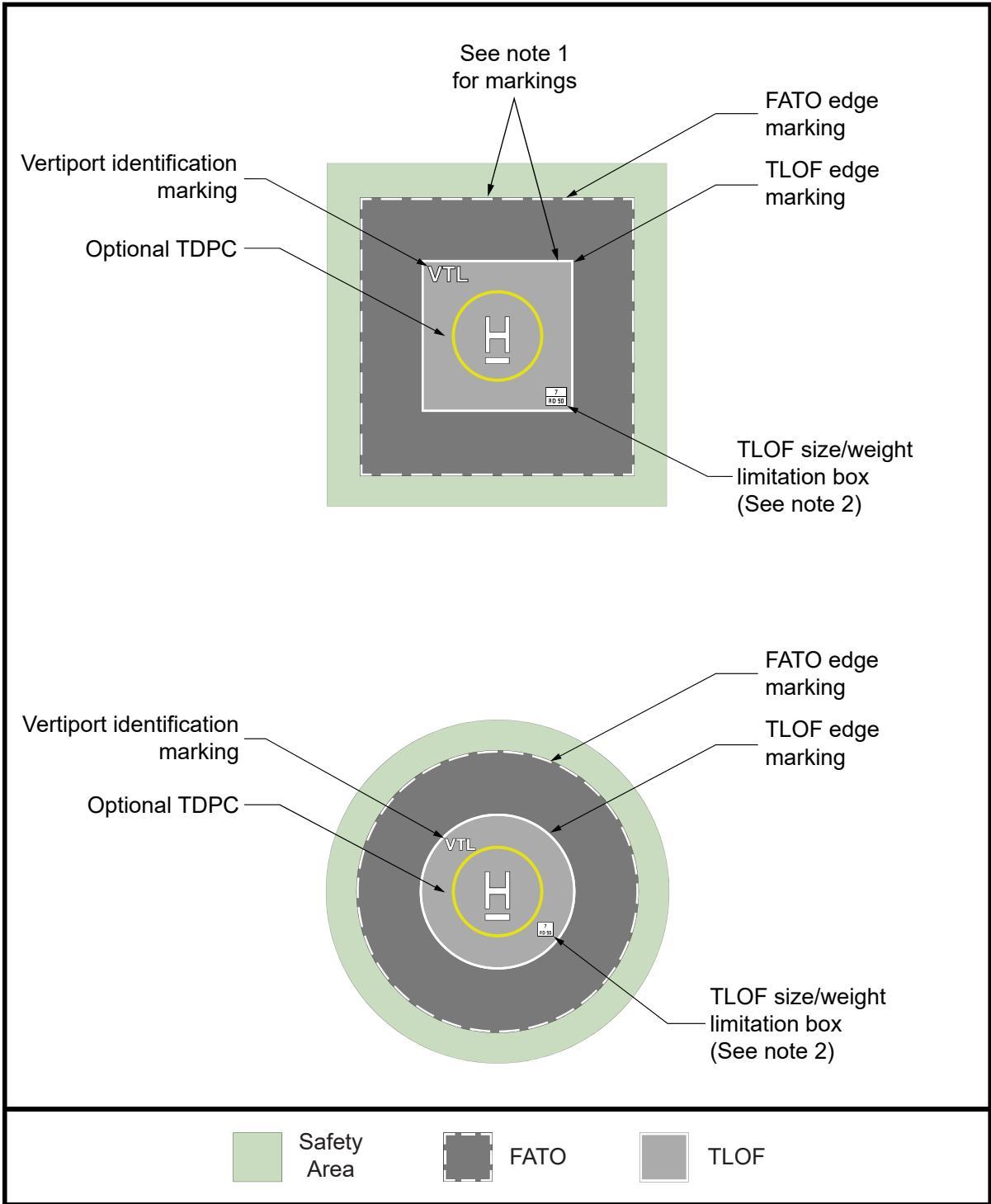
Figure is configured for 50-foot (15.2 m) TLOF.
Solid and dashed white lines are 12 inches (305 mm) in width. Dashed lines are 5-foot (1.5 m) in length with 5-6-foot (1.5-1.8 m) spaces. Solid yellow TDPC circle is 18 inches (0.5 m) in width.
See Figure 4-2 for details on the TLOF size/weight limitation box.
See Figure 4-2 for details on the “H” and “VTL”.
4.2. Identification Symbol.
The heliport identification symbol and vertiport identification marking identify the location as a vertiport, marks the TLOF, and provides visual cues to the pilot. Vertiport facilities should use the “H” shown in Figure 4-2. Also see Figure 4-2 for dimensional standards for these markings. Guidelines for this marking include:
-
Locate the “H” in the center of the TLOF and orient it on the axis of the primary preferred approach/departure path.
-
Place a one-foot-wide bar 2 feet (0.6 m) below the “H”, the width of the “H”, when it is necessary to distinguish the preferred approach/departure direction. See Figure 4-1.
-
A "VTL" marking must be used to indicate a Vertiport. Text height is a minimum of
3 feet (0.9 m) and a maximum of 5 feet (1.5 m). The preferred height is 5 feet (1.5 m).
4.3. TLOF Size/Weight Limitation Box.
The TLOF size/weight limitation box indicates the controlling dimension (maximum length or width) and the maximum takeoff weight of the Design VTOL aircraft that can use the vertiport. Weight limitation boxes should meet the following guidance:
-
The letters “RD” and the weight, in imperial units, of the Design VTOL aircraft that the vertiport is designed to accommodate are in a box in the lower right-hand corner of a rectangular TLOF, or on the right-hand side of the symbol of a circular TLOF, when viewed from the preferred approach direction.
-
The numbers are black on a white background.
-
The top number is the maximum takeoff weight of the Design VTOL aircraft in thousands of pounds for the Design VTOL the TLOF will accommodate. It is centered in the top half of the box.
-
The bottom number is the controlling dimension of the Design VTOL aircraft, is centered in the bottom half of the box, and is preceded by the letters “RD.”
-
A TLOF without a weight limit is marked with a diagonal line extending from the lower left-hand corner to the upper right-hand corner in the upper section of the TLOF size/weight limitation box.
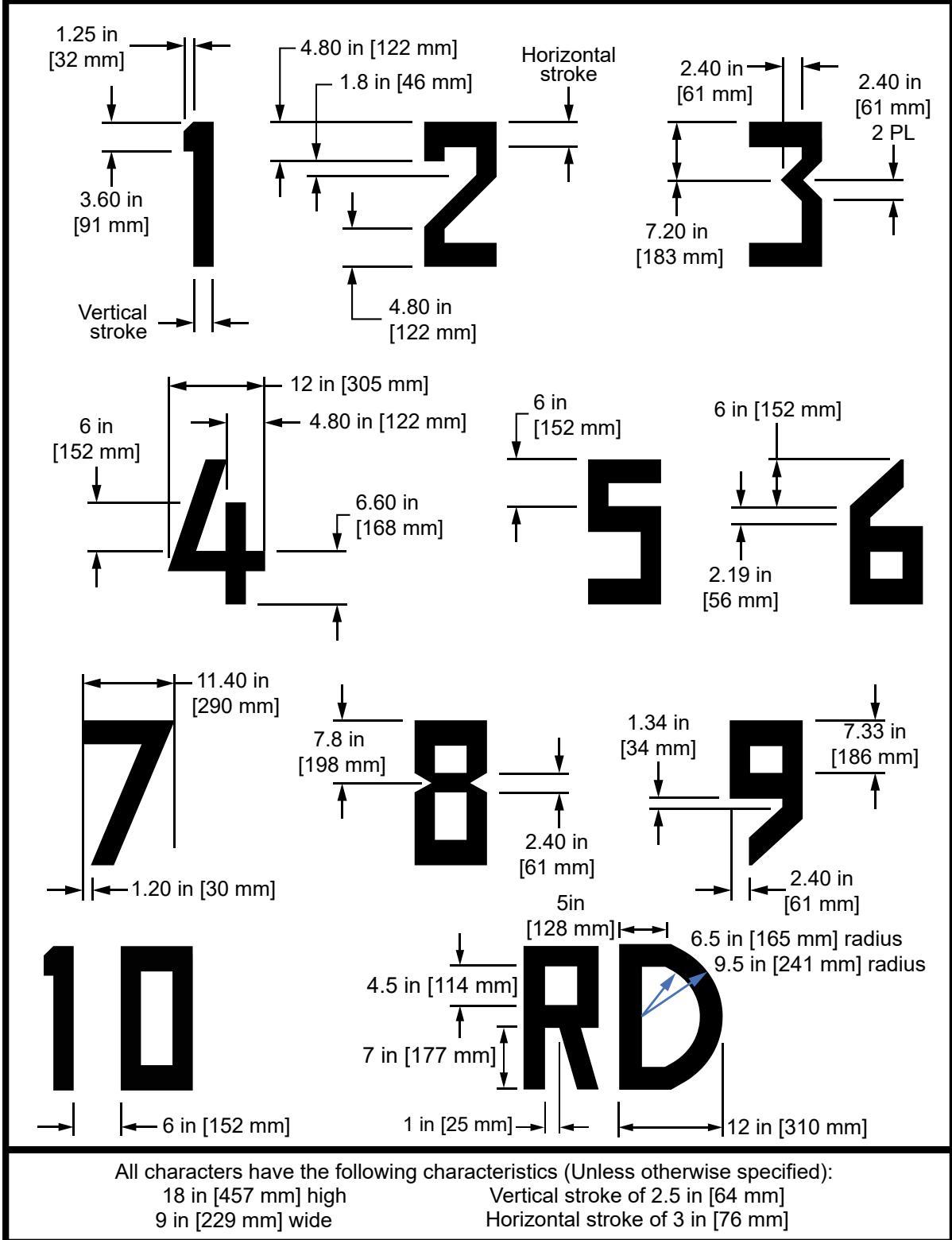
See Figure 4-2 for details on the TLOF size/weight limitation box, and Figure 4-3 and Figure 4-4 for details on the form and proportions of the numbers and letters specified for these markings.
Figure 4-2: Heliport Identification Symbol
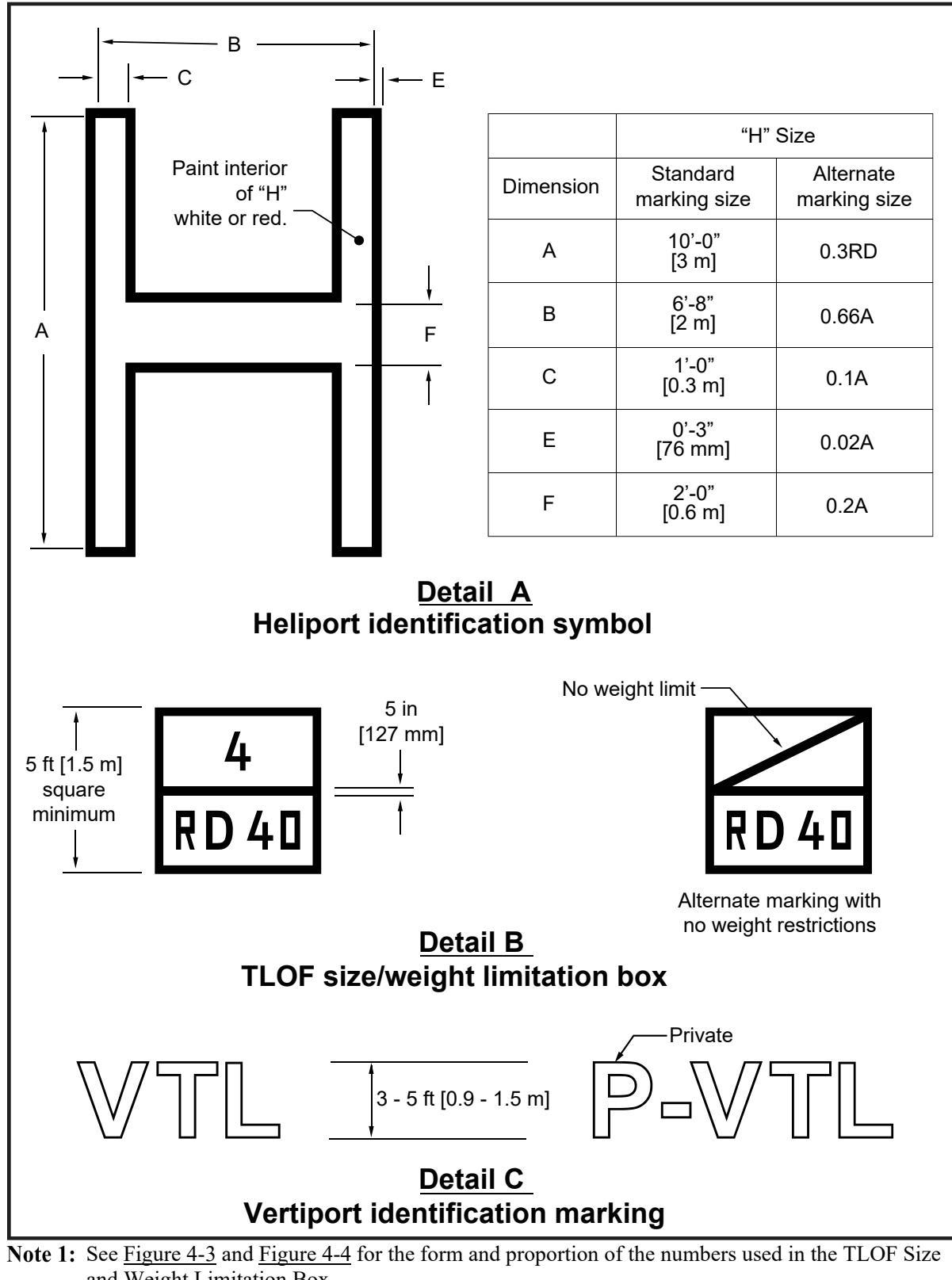
The minimum size of the box is 5 ft (1.5 m) square. Where possible, increase this dimension to a 10 ft (3 m) square for improved visibility.
For hospital marking alternatives, refer to AC 150/5390-2.
Figure 4-3: Form and Proportions of 36-inch (914 mm) Numbers for Marking Size and Weight Limitations
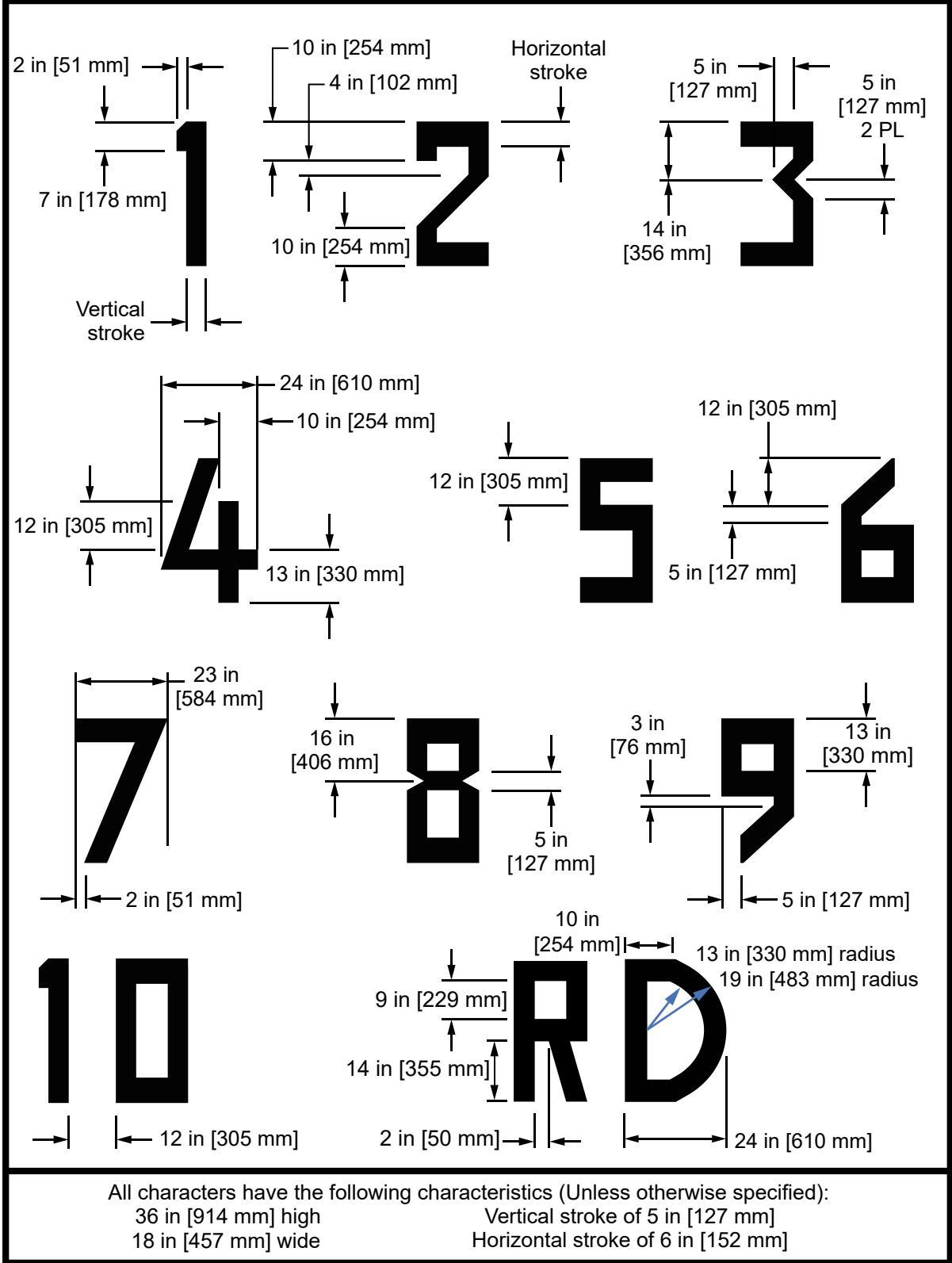
Figure 4-4: Form and Proportions of 18-inch (457 mm) Numbers for Marking Size and Weight Limitations
4.4. Flight Path Alignment Optional Marking and Lighting.
Flight path alignment marking and lighting is optional and includes markings and/or lights when it is desirable and practicable to indicate available approach and/or departure flight path direction(s). Guidance for optional flight path alignment marking and lighting includes:
-
The shaft of each arrow is 1.5 ft (0.5 m) wide and at least 10 feet (3 m) long.
-
The arrow heads are 5 feet (1.5 m) wide and 5 feet (1.5 m) tall.
-
The color of the arrow must provide good contrast against the background color of the surface. Provide a contrasting border around the arrows if needed to increase visibility for the pilot.
-
An arrow pointing toward the center of the TLOF depicts an approach direction.
-
An arrow pointing away from the center of the TLOF depicts a departure direction.
-
In-pavement flight path alignment lighting is recommended. See paragraph 4.5 for additional guidance. For elevated lights, if the TLOF light conflicts with a flight path alignment light, remove the conflicting flight path alignment light fixture.
-
For a vertiport with a flight path limited to a single approach direction or a single departure path, the arrow marking is unidirectional (i.e., one arrowhead only). For a vertiport with only a bidirectional approach/takeoff flight path available, the arrow marking is bidirectional (i.e., two arrowheads).
-
Flight path alignment arrow lighting is recommended for night operations and includes a minimum of three lights spaced 5-10 feet (1.5 to 3 m) apart. These lights may extend across the TLOF, FATO, Safety Area, or any suitable surface in the immediate vicinity of the FATO or Safety Area, if necessary.
See Figure 4-5 for additional guidance.
Figure 4-5: Flight Path Alignment Marking and Lighting
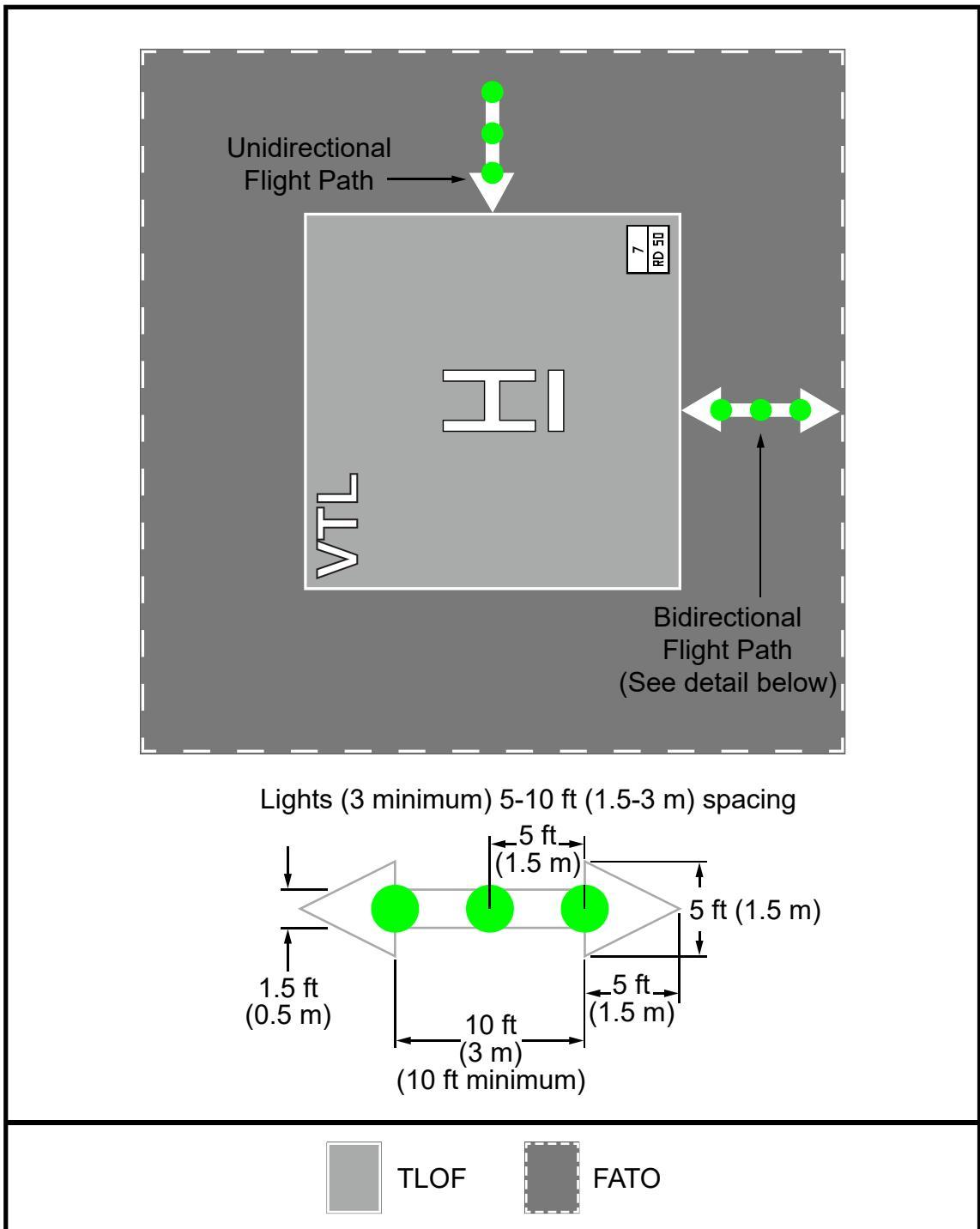
Figure is configured for 50-foot (15.2 m) TLOF.
Arrowheads have constant dimensions.
If necessary, adjust stroke length to match length available. Minimum length = 10 ft (3 m).
Light type: omnidirectional green lights, Type L-861H or L-852H.
If necessary, locate the lights outside of the arrow.
In-pavement flight path alignment lighting is recommended.
See paragraph 4.4 for guidance on flight path alignment markings.
Flight path alignment marking and lighting may extend into the TLOF.
4.5. Lighting.
Lighting is required for vertiports that support night operations. The lighting should enable the pilot to both establish the location of the vertiport and identify the perimeter of the operational area. In-pavement lighting is preferred to elevated lighting. The following guidelines apply to lighting:
4.5.1. General.
For additional guidance on perimeter lighting for surface level vertiports, see Figure 4-6.
For guidance for lighting for elevated vertiports, see Figure 4-7 and Figure 4-8.
-
Use FAA type L-861H elevated omnidirectional green and L-852H in-pavement omnidirectional green light fixtures for TLOF and FATO perimeter, flight path alignment, and approach/landing direction lighting applications. The specifications for these light fixtures will be found in AC 150/5345-46, Specification for Runway, Taxiway, Heliport, and Vertiport Light Fixtures, and EB 67, Light Sources Other Than Incandescent and Xenon For Airport and Obstruction Lighting Fixtures. See AC 150/5390-2 for additional information.
-
The elevated light emitting diode (LED) vertiport fixture and LED in-pavement fixtures are identified as L-861H (L) and L-852H (L), respectively. Some LED light fixtures may not be compatible with the use of some night vision goggle systems.
-
Perimeter light fixtures must meet chromaticity requirements for “aviation green” per SAE AS 25050, Colors, Aeronautical Lights and Lighting Equipment, General Requirements, when using incandescent lights. For light fixtures that use LEDs, see the standards in EB 67.
-
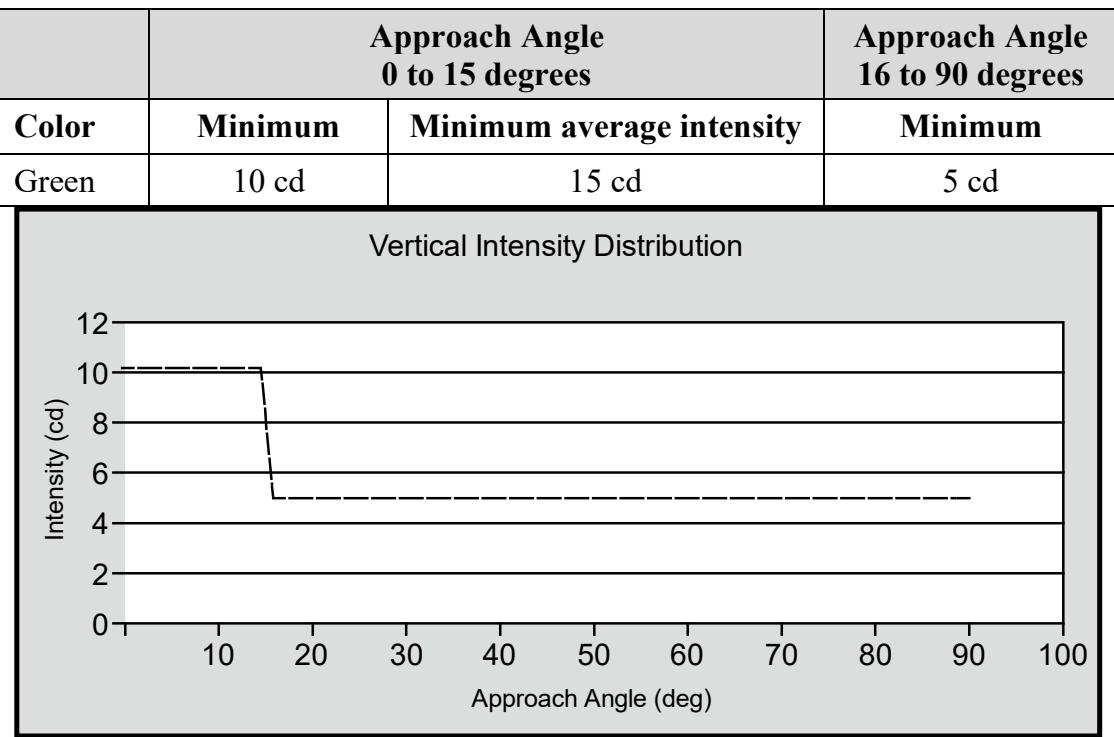
Photometric standards for perimeter light fixtures are included in Table 4-1. See AC 150/5345-46 for detailed measurement methods and standards.
-
Elevated perimeter light fixtures will be installed in a load-bearing light base (L-868, Size B) or non-load-bearing light base (L-867, Size B) per AC 150/5345-42, Specification for Airport Light Bases, Transformer Housings, Junction Boxes, and Accessories. Shallow base type light bases will not be used.
-
Installation of vertiport lighting is to be in accordance with AC 150/5340-30, Design and Installation Details for Airport Visual Aids.
Table 4-1: Perimeter Lighting Intensity and Distribution
| Approach Angle0 to 15 degrees | Approach Angle16 to 90 degrees | ||
| Color | Minimum | Minimum average intensity | Minimum |
| Green | 10 cd | 15 cd | 5 cd |
4.5.2. In-Pavement Perimeter Lights on TLOF and FATO.
-
TLOF perimeter lights are green and FAA type L-861H (AC 150/5345-46) or FAA type L-852H. LED versions of FAA type L-861H and L-852H are per AC 150/5345- 46 and EB 67.
-
A square TLOF has:
a. One light in each corner.
b. Lights uniformly spaced between the corners with no less than five lights on each side including the corners.
c. Lights spaced no more than 25 feet (7.6 m) apart.
d. A light along the centerline of the approach.
- A circular TLOF has:
a. An even number of lights
b. Minimum of eight lights uniformly spaced.
-
TLOF lights are within 1 foot (0.3 m) inside or outside of the perimeter line.
-
FATO perimeter lights are optional.
-
If installed, FATO perimeter lights are green and FAA type L-861H (AC 150/5345- 46) or FAA type L-852H. LED versions of FAA type L-861H and L-852H are per AC 150/5345-46 and EB 67.
-
A square FATO has:
a. One light in each corner.
b. Lights uniformly spaced between the corners with no less than five lights on each side.
c. Lights spaced no more than 25 feet (7.6 m) apart.
d. A light along the centerline of the approach.
- A circular FATO has:
a. An even number of lights
b. Minimum of 8 lights uniformly spaced.
- FATO lights are within 1 foot (0.3 m) of the inside or outside of the perimeter line.
Figure 4-6: TLOF/FATO Lighting
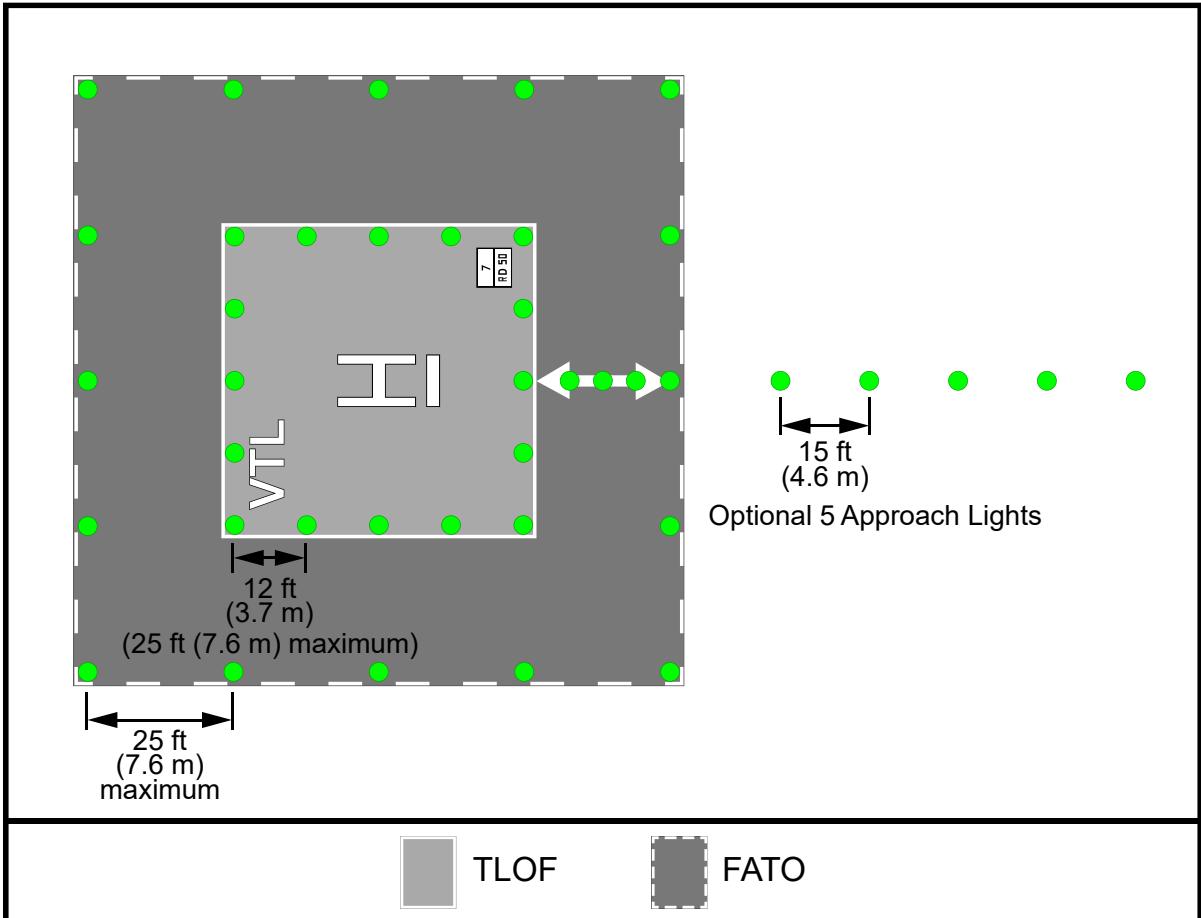
In-pavement lights are within 1 foot (0.3 m) of the inside or outside of the TLOF and FATO respective perimeters.
Elevated lights are outside and within 10 feet (3 m) of TLOF and FATO respective perimeters.
Exhibit is configured for 50-foot (15.2 m) TLOF.
Figure 4-7: Elevated Vertiport Configuration Example
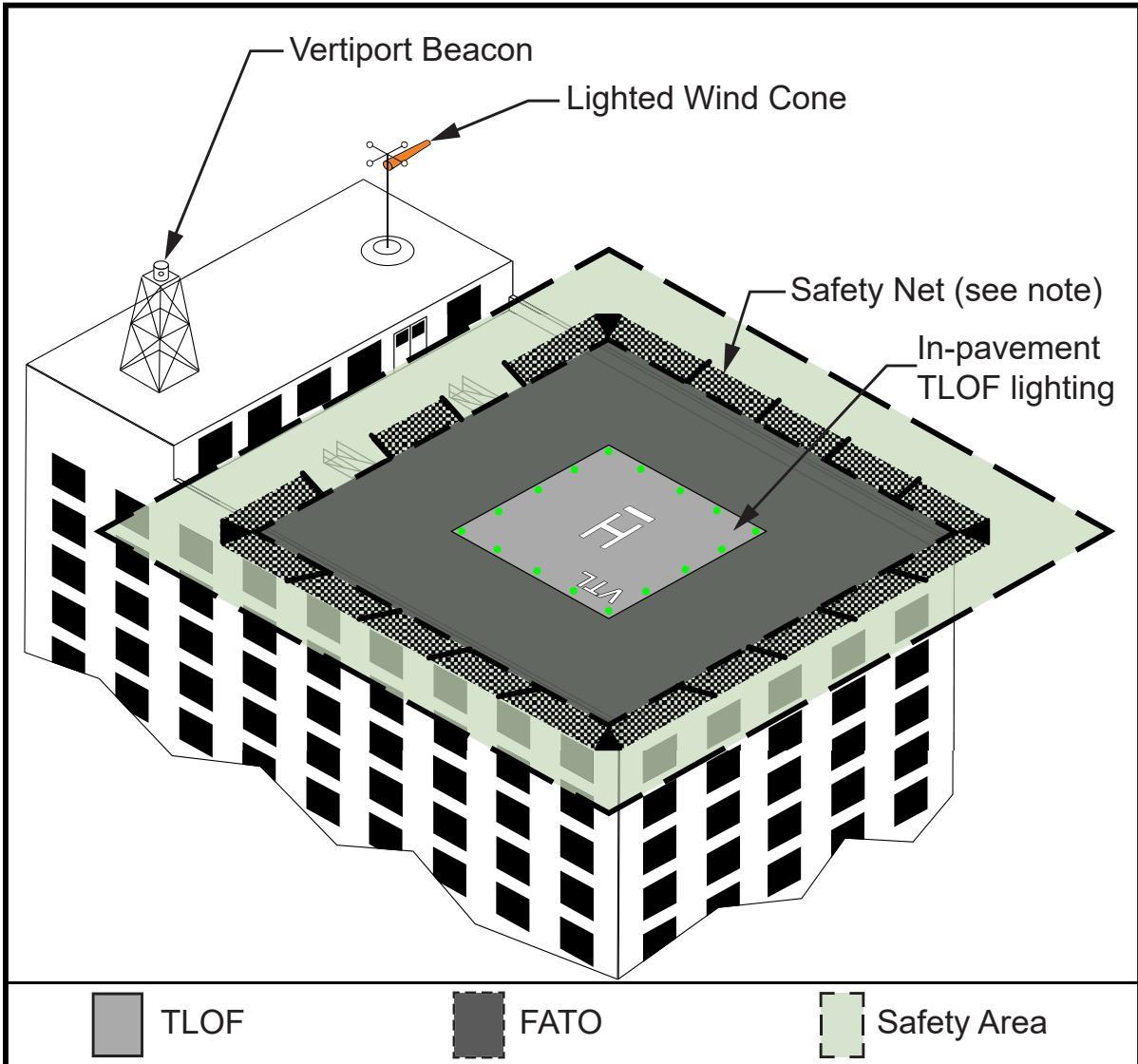
Note: See Figure 4-8 for safety net and lighting details.
Figure 4-8: Elevated FATO Perimeter Lighting
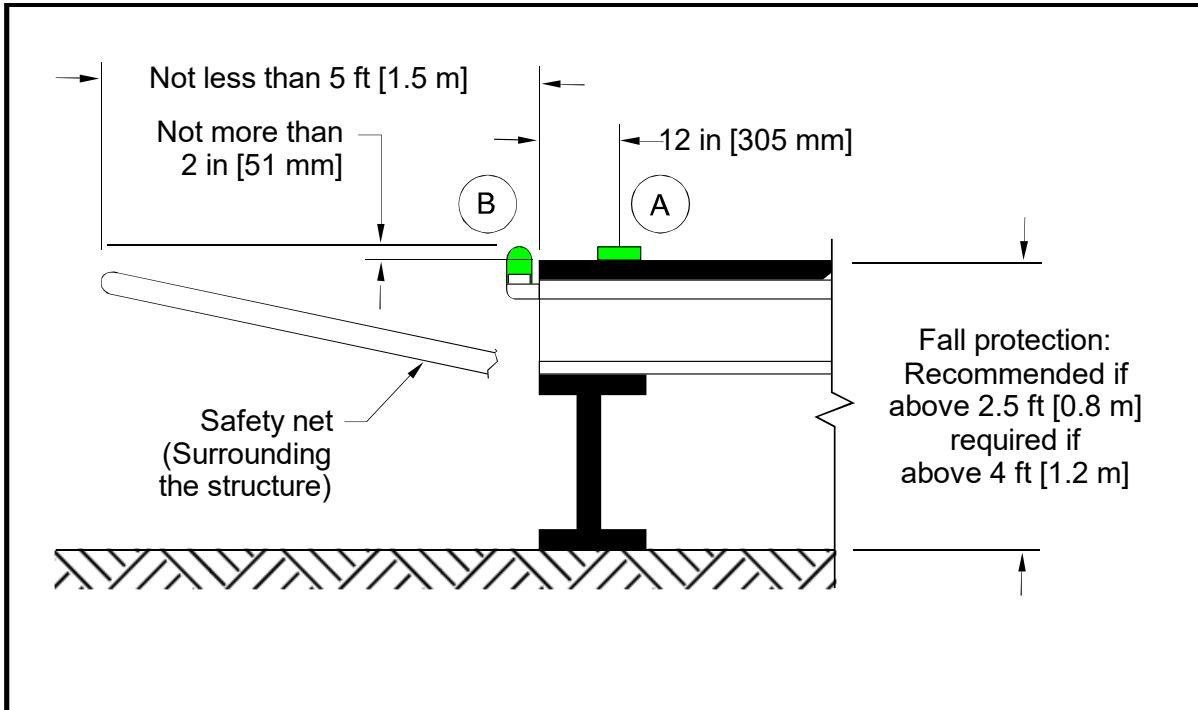
Install either “A” Type L-852H, or “B” Type L-861H.
In-pavement edge light fixture Ⓐ (Type L-852H).
Omnidirectional light Ⓑ, mounted off the structure edge (Type L-861H).
Ensure elevated lights do not penetrate a horizontal plane at the TLOF elevation by more than 2 inches (51 mm).
For TLOF and FATO lighting standards, see AC 150/5345-46 and EB 67.
A safety net’s supporting structure must be located below the safety net.
4.5.3. Elevated Perimeter Lights on TLOF and FATO.
The same standards for in-pavement lights apply to elevated lights except for the following:
-
Lights are omnidirectional.
-
Lights are on the outside edge of the TLOF and FATO.
-
Lights are on frangible elevated light fixtures, no more than 2 inches (51 mm) above the TLOF surface, and no more than 10 feet (3 m) out from the TLOF and FATO, respective, perimeters.
-
Lights do not penetrate a horizontal plane at the TLOF edge elevation by more than 2 inches (51 mm), as shown in Figure 2-3.
See additional information in Figure 4-6.
4.5.4. Visual Glideslope Indicators (VGSI).
A VGSI provides pilots with visual vertical course and descent cues. Install the VGSI such that the lowest on-course visual signal provides a minimum of one degree of clearance over any object that lies within ten degrees of the approach course centerline.
4.5.4.1. Siting.
-
The optimum location of a VGSI is on the extended centerline of the approach path at a distance that brings the VTOL to a hover with the undercarriage between 3 and 8 feet (0.9 to 2.4 m) above the TLOF.
-
To properly locate the VGSI, estimate the vertical distance from the undercarriage to the pilot’s eye.
4.5.4.2. Control of the VGSI.
Design the VGSI to be pilot controllable such that it is “on” only when needed as an option.
4.5.4.3. VGSI Needed.
A VGSI is an optional feature. However, install a VGSI if one or more of the following conditions exist, especially at night:
-
Obstacle clearance, noise abatement, or traffic control procedures necessitate a slope to be flown.
-
The environment of the VTOL provides few visual surface cues.
4.5.4.4. Additional Guidance.
Additional guidance is provided in AC 150/5345-52, Generic Visual Glideslope Indicators (GVGI), and AC 150/5345-28, Precision Approach Path Indicator (PAPI) Systems.
4.5.5. Approach Lighting.
Approach lights are optional. When installed they include a line of five green omnidirectional lights located on the centerline of the preferred approach/departure path. The first light is 30 to 60 feet (9.1 to 18.3 m) from the TLOF. Remaining lights are spaced at 15-foot (4.6 m) intervals aligned on the centerline of the approach path. See Figure 4-6.
4.5.6. Floodlight Option.
The FAA has not evaluated floodlights for effectiveness in visual acquisition of a vertiport. Guidelines for the use and installation of floodlights include:
-
Install floodlights to illuminate the TLOF, the FATO, and/or the parking area if ambient light does not suitably illuminate markings for night operations.
-
Mount these floodlights on adjacent buildings to eliminate the need for tall poles, if possible. Place floodlights clear of the TLOF, the FATO, the Safety Area, the approach/departure surfaces, and transitional surfaces and ensure floodlights and their associated hardware do not constitute an obstruction hazard.
-
Aim floodlights down to provide adequate illumination on the apron and parking surface.
-
Ensure floodlights that might interfere with pilot vision during takeoff and landings are capable of being turned off by pilot control or at pilot request.
Note 1: Floodlights do not replace TLOF or FATO lighting recommendations.
Note 2: White lighting for heliport applications should not be activated until the aircraft has landed and deactivated prior to takeoff.
4.6. Identification Beacon.
An identification beacon, FAA type L-801H Medium intensity heliport beacon, is required for night operations. The identification beacon is flashing white/yellow/green with a rate of 30 to 45 flashes per minute. On-airport vertiports are not required to have a vertiport identification beacon. Install beacons per the heliport guidance below:
-
AC 150/5345-12, Specification for Airport and Heliport Beacons, provides specifications for a beacon.
-
AC 150/5340-30 provides guidelines for installing a beacon.
4.7. Wind Cone.
Wind cones provide the direction and magnitude of the wind. The following guidelines apply to wind cones:
-
Minimum of one wind cone conforming to AC 150/5345-27, FAA Specification for Wind Cone Assemblies.
-
Orange in color to provide the best possible contrast to its location’s background.
-
Locate to provide valid wind direction and speed information near the vertiport under all wind conditions.
-
Visible to pilots on the approach path when the aircraft is 500 feet (152 m) from the TLOF.
-
Visible to pilots from the TLOF.
-
Located within 500 feet (152 m) horizontal of the TLOF.
-
If one location does not provide for all the above, multiple locations may be necessary to provide pilots with all the wind information needed for safe operations.
-
See AC 150/5345-27 and AC 150/5340-30 for primary and secondary wind cones for multiple wind cone requirements.
-
Located outside the Safety Area and does not penetrate the approach/departure or transitional surfaces.
-
Follows installation details specified in AC 150/5340-30.
-
Lighted internally or externally for night operations.
5.0 Charging and Electric Infrastructure.
Most early concepts of operation for AAM activity indicate the use of electric propulsion by VTOL aircraft. The electrical needs for these aircraft vary based on design and manufacturer. This EB addresses battery driven technologies. Future guidance will be provided on other emerging energy concepts (e.g., hydrogen).
Electrification of aviation propulsion systems is an evolving area with few industryspecific standards. In addition to relevant national, state, and local building codes, the following sections provide a partial list of relevant standards that may assist when specifying charging systems and facility layout for this emerging industry. Current charging standards for light duty vehicle charging (up to 350kw) align with multiple light electric aircraft currently applying for certification. However, for meeting operational characteristics of higher capacity batteries and novel systems, manufacturers and operators may implement, along with fixed-charger equipment, alternate charging methods including mobile charging systems, fixed battery storage, cable and/or on-board battery cooling, battery swapping, or other concepts.
At the time of this publication, consensus has not been achieved regarding classes of charging or connection standards and could vary based on the aircraft duty cycle, charging speed, battery chemistry, charging system, and battery cooling system, etc. Charging infrastructure design for vertiports should consider adapting to multiple aircraft specific systems. Additional guidance is currently being developed as the AAM industry continues to evolve. When siting charging stations and equipment, consider all potential safety hazards and guidance in the other sections of this EB.
Battery charging must be done in a safe and secure manner. Any aircraft batteries stored on site should be stored safely away from TLOF, FATO, and safety areas and not penetrate the approach/departure surfaces, and be in accordance with all applicable building codes, fire codes, and NFPA Standards. As additional research is developed, further recommendations will be released.
5.1. Standards.
5.1.1. Airport/Vertiport Fire Fighting and Safety Considerations.
2021 International Fire Code (IFC): To implement alternative energy vectors, there is the need for general precautions, emergency planning and preparedness, and storage of hazardous materials.
NFPA 110, Standard for Emergency and Standby Power Systems: To ensure the continuity of electric aircraft operations, uninterrupted power supply is needed thus creating a need for guidelines on emergency and backup power supply systems.
NFPA 70, NEC Article 625 - Electric Vehicle Charging System: Covers the electrical conductors and equipment external to an electric vehicle that connect an electric vehicle to a supply of electricity by conductive or inductive means, and the installation of equipment and devices related to electric vehicle charging. It also
addresses scenarios that would allow the use of load balancing functions on electrical supply systems.
NFPA 70, Article 706 - Energy Storage Systems: This article applies to all energy storage systems (ESS) having a capacity greater than 3.6 mJ (1 kWh) that may be standalone or interactive with other electric power production sources. These systems are primarily intended to store and provide energy during normal operating conditions.
NFPA 400, Hazardous Materials Code: Covers the minimum NFPA standards for the storage and handling of hazardous materials such as lithium batteries.
NFPA 415, Standard on Airport Terminal Buildings, Fueling Ramp Drainage, and Loading Walkways: The purpose of this standard is to protect life and property from fire at airport terminal complexes.
NFPA 418, Standard for Heliports and Vertiports: This standard establishes fire safety standards for operations of heliports and rooftop hangars for the protection of people, aircraft, and other property. Future editions of this standard will include electric mobility asset considerations.
NFPA 855, Standard for the Installation of Stationary Energy Storage Systems: Covers the minimum NFPA standards established for design, installation, and maintenance of a stationary energy storage system including battery storage systems.
5.1.2. Occupational Safety and Health Administration Considerations.
29 CFR § 1910.176, Handling Materials – General: This standard provides the minimum requirements for the storage and handling of hazardous materials such as lithium batteries.
5.1.3. Power Quality Considerations.
IEEE 519-2014, IEEE Recommended Practice and Requirements for Harmonic Control in Electric Power Systems: The grid impact of high wattage charging stations needs to be considered when designing and adopting charging stations. This standard provides guidance in the design and compliance of power systems with nonlinear loads.
IEEE 1826-2020, IEEE Standard for Power Electronics Open System Interfaces in Zonal Electrical Distribution Systems Rated Above 100 kW: Airports require power, monitoring, information exchange, control, and protection of interfaces that are based on technological maturity, accepted practices, and allowances for future technology insertions such as the integration of electric aircraft.
5.1.4. Underwriter’s Laboratories (UL) Certifications Considerations.
The following standards focuses on certifying the components and safety of the systems.
UL 2202, Standard for Safety of Electric Vehicle (EV) Charging System Equipment: Covers conducting charging system equipment (600 volts or less) for recharging batteries in surface electric vehicles.
UL 2251, Standard Testing for Charging Inlets and Plugs: Covers plugs, receptacles, vehicle inlets, and connectors rated up to 800 amperes and up to 600 volts AC or DC, and intended for conductive connection systems, for use with electric vehicles.
• UL 2580, Batteries for Use in Electric Vehicles: Covers electric equipment storage assemblies in electric powered vehicles.
UL 9540, Energy Storage System (ESS) Requirements - Evolving to Meet Industry and Regulatory Needs: This key standard encompasses the design, commissioning, operation, decommissioning, and emergency operations for all energy storage systems.
UL 9540a, Test Method.
5.1.5. Vehicle to Infrastructure Considerations.
SAE J1772, SAE Electric Vehicle and Plugin Hybrid Electric Vehicle Conductive Charge Coupler: This standard was developed to define the fit and function of a conductive coupler for use in charging electric vehicles. It was later expanded to include direct current (DC) charging through combined alternating current/direct current (AC/DC) physical connector referred to as the Combined Charging Standard (CCS).
SAE AIR7357, MegaWatt and Extreme Fast Charging for Aircraft (under development): This standard is a work in progress under SAE leadership and intended to provide a charging interface for battery packs from 150kWh-1MWh within aircraft.
Megawatt Charging System (MCS): The MCS is intended to extend the capabilities of the CCS to accommodate the charge rate demands of larger vehicles and thus serve the trucking and aviation sectors. Ratings should exceed 1MW (max 1,250 volt and 3,000 ampere (DC)) while also addressing communication and controls using ISO/IEC 15118-1:2019 and meeting UL 2251 touch safe standards.
ISO/IEC 15118-1:2019, Road Vehicles: Vehicle to Grid Communication Interface: This standard defines the digital communications protocol to be used for the charging of high voltage electric vehicle batteries from a charging station. Beyond the basic handshakes and charge control between a vehicle and a charging station, this standard also includes convenience and security layers that support the “plug and charge” experience. Additionally, it offers the potential to schedule and coordinate the charging demands with the grid conditions.
5.2. Other Information.
5.2.1. National Renewable Energy Laboratory (NREL) Federal Aviation Administration Vertiport Electrical Infrastructure Study. With the introduction of eVTOL aircraft, electrical charging loads will be added at the vertiports along with building loads and distributed energy resources (DERs). The key research challenge is the optimization of megawatt-scale building loads, charging loads, energy storage, and renewables production. To better understand vertiport infrastructure requirements, the FAA identified multiple stakeholders in the Report including aircraft manufacturers, electric utilities, potential site property owners, and local communities to evaluate their unique operational needs.
5.2.2. NREL Overview of Potential Hazards in Electric Aircraft Charging Infrastructure. The objective of this Report is to document and help familiarize the FAA and airport authorities with the potential hazards associated with the deployment of electric aircraft and the associated charging infrastructure. The list and examples of these hazards are non-exhaustive, and multiple hazards can occur simultaneously. This Report discusses natural, human, and technological causes that can lead to fire (thermal), physical, or chemical hazards. Applicable standards and guidelines associated with electric vehicle supply equipment (EVSE) infrastructure are available for reference in the appendix. These sources, which address diverse geographic location and climate considerations, can help operators in site selection for EVSE, mitigation planning, deployment considerations, and training of staff to handle these situations.
5.2.3. NREL Addressing Electric Aviation Infrastructure Cybersecurity Implementation. This Technical Report evaluates key considerations of cybersecurity systems in preparation for the electrification of both legacy and new aviation services. The objectives are to consider the landscape of components and interconnections, review sensitivities and the criticality of operational data, consider applicability of existing best practices, and identify gaps associated with the cybersecurity of electric charging systems for the aviation sector. It is noted that cybersecurity analysis is a key component of the overall hazard analysis for aviation electrical infrastructure necessary for safely providing energy to aircraft.
6.0 On-Airport Vertiports.
To support VTOL operations, certain OEMs and operators are interested in developing vertiports on airports and modifying existing on-airport helicopter landing facilities. All federally obligated airport sponsors are required to ensure the safety, efficiency, and utility of the airport and to provide reasonable and not unjustly discriminatory access to all aeronautical users.
This chapter addresses design considerations for separate vertiport facilities on airports. There may be locations on an airport where VTOLs can operate without interfering with airplane traffic and operations. Operations can occur on existing airport infrastructure for its intended purpose or on dedicated vertiport facilities.
Separate vertiport facilities and approach/departure procedures may be needed when the volume of airplane and/or VTOL traffic affects operations. Airports with interconnecting passenger traffic between VTOLs and fixed-wing aircraft should generally provide access between the respective terminals for boarding with applicable security measures in place.
Any new vertiport infrastructure or fixed equipment must be depicted on the ALP and submitted for FAA review prior to development and operation. For projects subject to FAA approval, an appropriate level of environmental review under the National Environmental Policy Act (NEPA) is required. These on-airport vertiport facilities must follow all guidance detailed in this EB.
For facilities being built on non-federally obligated airports, in compliance with Part 157, the sponsor or proponent must submit Form 7480-1 at least 90 days in advance of the day that construction work is to begin on the vertiport takeoff and landing area.
See Appendix A for air traffic considerations for siting vertiports on or near existing airports.
6.1. On-Airport Location of TLOF.
Locate the TLOF to provide ready access to the airport terminal with applicable security measures in place or to the VTOL user’s origin or destination. If needed, locate the TLOF away from, but with access to, fixed-wing aircraft movement areas (the runways, taxiways, and other areas of an airport that are used for taxiing, takeoff, and landing of aircraft, exclusive of loading ramps and aircraft parking areas).
6.2. On-Airport Location of FATO.
See Table 6-1 for standards of the distance between the centerline of an approach to a runway and the centerline of an approach to a vertiport’s FATO for simultaneous, samedirection VFR operations. Figure 6-1 depicts an example of an on-airport Vertiport location. The FATO should be located outside of all object free areas (OFAs), Safety Areas, runway protection zones, and safety critical navigational aid areas, as defined in AC 150/5300-13, Airport Design.
Table 6-1: Recommended Minimum Distance between Vertiport FATO Center to Runway Centerline for VFR Operations
| ReferenceVTOL AircraftMTOW | Airplane Size | Distance FromVertiport FATO Centerto Runway Centerline |
| 12,500 1bs (5,670kg) or less | Small Airplane (12,500 1bs (5,670 kg) or less)) | 500 feet (152 m) |
| 12,500 1bs (5,670kg) or less | Large Airplane (12,501-300,000 1bs (5,670.4-136,079 kg)) | 500 feet (152 m) |
| 12,500 1bs (5,670kg) or less | Heavy Airplane (Over 300,000 1bs (136,079 kg)) | 700 feet (213 m) |
Figure 6-1: Example of an On-airport Vertiport
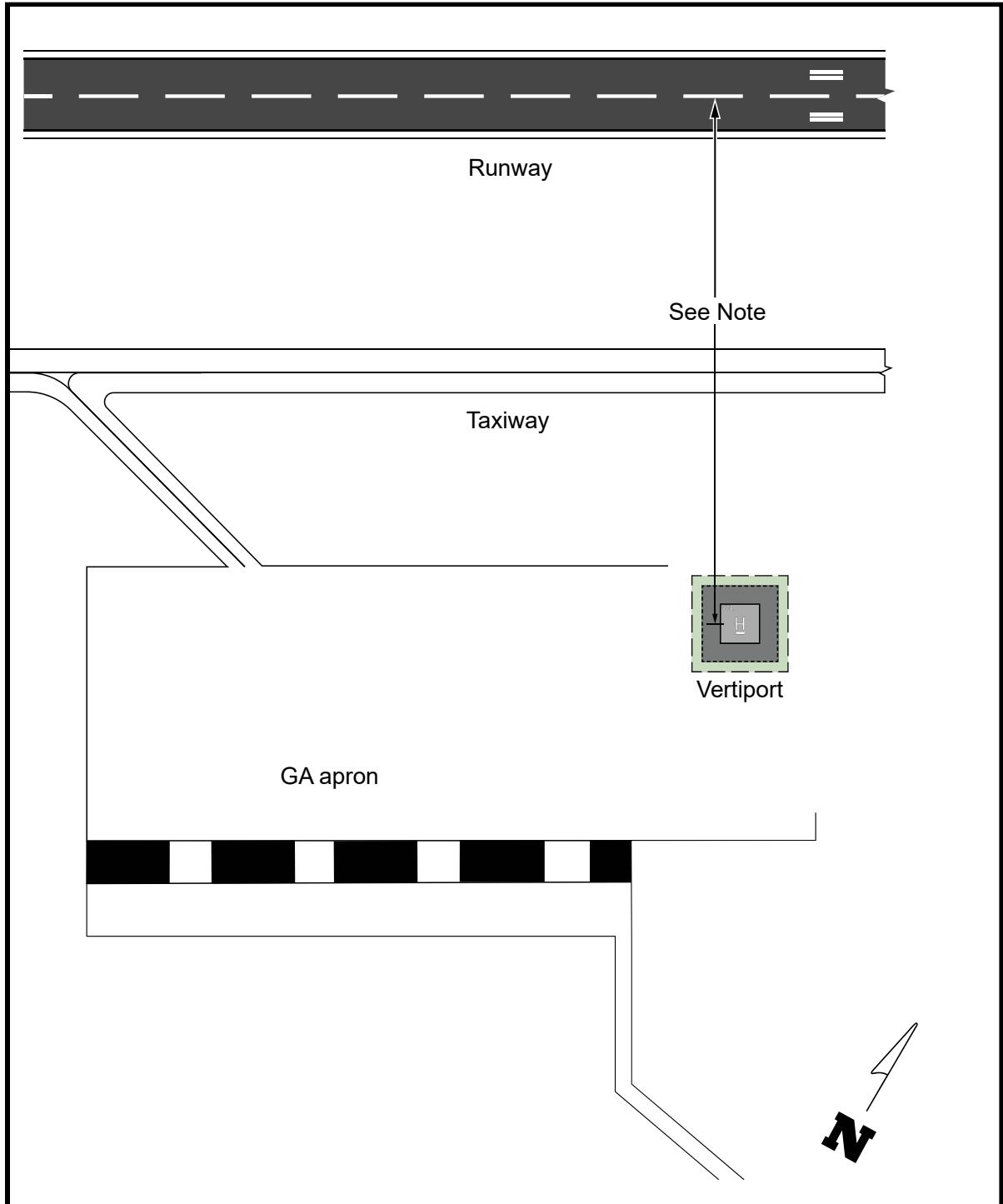
Note: See Table 6-1.
Note: Figure does not reflect every type of configuration.
7.0 Site Safety Elements.
7.1. Fire Fighting Considerations.
Refer to NFPA 418, Standard for Heliports and Vertiports, for the most current guidance on fire protection. Refer to NFPA 855, Standard for the Installation of Stationary Energy Storage Systems, for guidance on safety standards for stationary and mobile energy storage systems. Chapters on emergency response provide relevant guidance for fire protection engineers, system designers, code officials, and emergency responders.
7.2. Security and Safety.
For vertiports located in secured airport environments, unless screening was carried out at the VTOL passengers’ departure location, Transportation Security Administration regulations may require that a screening area and/or screening be provided before passengers enter the airport’s secured areas. If necessary, airports should establish multiple VTOL parking positions and/or locations in the terminal area to service VTOL passenger screening and/or cargo needs. General information about passenger screening is available on the Transportation Security Administration website, https://www.tsa.gov/.
Controlling vertiport access and keeping operational areas clear of people, animals, equipment, debris, and vehicles is important for safety and security. The following guidance applies to safety barriers and access control measures:
-
For ground-level vertiports, erect a safety barrier around the VTOL aircraft operational areas in the form of a fence or a wall outside of the Safety Area and below the 8:1 elevation of the approach/departure surface. Other types of safety barriers may be used if they provide adequate positive deterrent to persons inadvertently entering an operational area and do not attract wildlife or negatively impact safety.
-
If necessary, near the approach/departure paths, install the barrier by placing it well outside the outer perimeter of the Safety Area and below the elevation of the approach/departure and transitional surfaces described in paragraph 2.5.
-
Safety barriers must be high enough to present a positive deterrent to persons inadvertently or maliciously entering an operational area, but at a low enough elevation to be non-hazardous to all aircraft operations.
-
Provide control access to airport airside areas with adequate security measures as required or recommended by the Transportation Security Administration.
-
Display a vertiport caution sign like that shown in Figure 6-2 at all vertiport access points.
-
Ensure all persons are outside of the DCA when aircraft are operating, as described in paragraph 2.5.
For on-airport vertiports, proponents coordinates with their local Transportation Security Administration security representative.
CAUTION VERTIPORT LANDING AREA
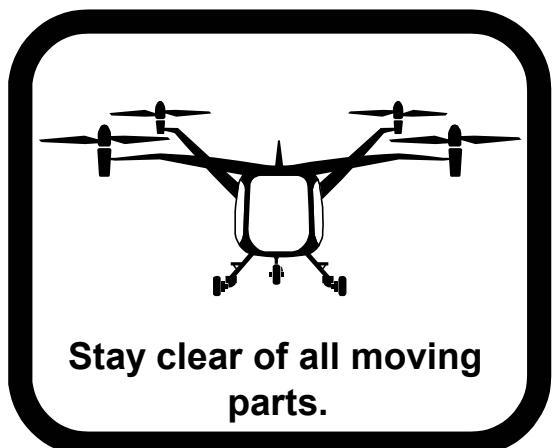
7.3. Wind and Turbulence.
Wind conditions affect all aircraft to some degree. A wind analysis is recommended to determine the primary approach path to the vertiport. The FAA recommends a data period covering at least the last ten consecutive years of wind observations for this analysis.
Additionally, air (e.g., wind) flowing around and over buildings, stands of trees, terrain irregularities, and elsewhere can create turbulence on ground-level and rooftop vertiports that may affect VTOL operations. The following guidelines apply to turbulence:
-
When possible, locate the TLOF away from buildings, trees, and terrain to minimize air turbulence near the FATO and the approach/departure paths.
-
Assess the turbulence and airflow characteristics near and across the surface of the FATO to determine if turbulence mitigating design measures are necessary (e.g., air gap between the roof, roof parapet, or supporting structure). Perform this assessment when the FATO is located near the edge and top of a building or structure, or within the influence of turbulent wakes from other buildings or structures. The FAA’s
Technical Report FAA/RD-84/25, Evaluating Wind Flow around Buildings on Heliport Placement, addresses the wind’s effect on helicopter operations.
-
Providing a minimum 6-foot (1.8 m) unobstructed air gap on all sides above the level of the top of a structure (e.g., roof and adjacent parapets and walls) and the elevated vertiport will reduce the turbulent effect of air flowing over it.
-
Where an air gap or other turbulence-mitigating design measures are not taken on elevated structures, operational limitations may be necessary under certain wind conditions.
-
Airflow and turbulence measuring equipment may be required for rooftop vertiports. The airflow around the vertiport will need to be assessed to determine how many airflow measurement devices may be needed to accurately characterize the airflow
7.4. Weather Information.
An optional automated weather observing system (AWOS) measures and automatically broadcasts current weather conditions at the vertiport site. When installing an AWOS, locate it at least 100 feet (30.5 m) and not more than 700 feet (213 m) from the TLOF and such that its instruments will not be affected by rotor/propeller wash from VTOL operations. Find guidance on AWOS systems in AC 150/5220-16, Automated Weather Observing Systems (AWOS) for Non-Federal Applications, and FAA Order 6560.20, Siting Criteria for Automated Weather Observing Systems (AWOS). Other weather observing systems will have different siting criteria. Further research is being conducted as other systems may be able to provide weather data.
7.5. Winter Operations.
Swirling snow dispersed by a VTOL’s rotor/propeller wash can cause the pilot to lose sight of the intended landing point and/or obscure objects that need to be avoided. Elevated vertiports may benefit from the incorporation of in-surface snow and ice melt systems.
-
Design the vertiport to accommodate the methods and equipment to be used for snow removal.
-
Design the vertiport to allow the snow to be removed sufficiently so it will not present an obstruction hazard or a flying debris hazard to persons and vehicles.
-
For vertiports in winter weather, an optional dark TLOF surface can be used to absorb more heat from the sun and melt residual ice and snow.
-
Find guidance on winter operations in AC 150/5200-30, Airport Field Condition Assessments and Winter Operations Safety.
7.6. Access to Vertiports by Individuals with Disabilities.
Congress has passed various laws concerning access to airports. Since vertiports are a type of airport, these laws are similarly applicable. Find guidance in AC 150/5360-14, Access to Airports by Individuals with Disabilities.
7.7. Electromagnetic Effects.
Nearby electromagnetic devices, such as a large ventilator motor, elevator motor, magnetic resonance imaging machine (MRI), or other devices that consume large amounts of electricity may cause temporary abnormalities in the VTOL magnetic compass and interfere with other onboard navigational equipment. Buried rebar or other objects made of iron/steel below the vertiport surface have also been shown to interfere with a VTOL’s navigation instruments.
Be alert to the location of any such devices with respect to hospitals. A warning sign alerting pilots to the presence of an MRI is recommended. Take steps to inform pilots of the MRI locations or other electromagnetic equipment that consume large amounts of electricity. Vertiports are recommended to include electromagnetic interference (EMI) hazard marking and signage to alert pilots to potential EMI impacts, as shown in Figure 6-2 and Figure 6-3. Locate the EMI hazard sign at ingress/egress points on the vertiport for maximum visibility.
For additional information, see the FAA’s Technical Report FAA/RD-92/15, Potential Hazards of Magnetic Resonance Imagers to Emergency Medical Service Helicopter Services.
Figure 6-3. Vertiport EMI Hazard Marking

Align the compass with magnetic north. Use arrows, as shown, to indicate the four cardinal headings (N, S, E, W) and four intercardinal headings (NE, SE, SW, and NW).
Use a minimum dimension of a 6-foot (1.8 m) outer diameter and a 4-foot (1.2 m) inner diameter for the compass circle.
Use blue paint for the compass circle and white paint for the inner portion of the compass. If necessary for visual contrast, use a one-foot white outline along the outer edge of the compass and arrows.
Figure 7-1. Vertiport EMI Hazard Sign
CAUTION
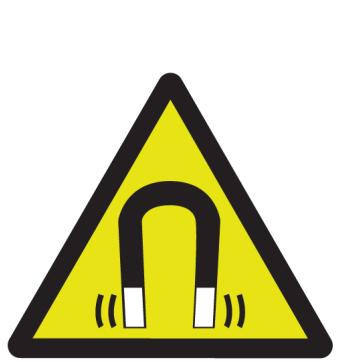
Strong Magnetic Field
instruments may be affected.
Confirm accuracy
during all operations.
APPENDIX A. AIR TRAFFIC CONSIDERATIONS FOR SITING VERTIPORTS ON OR NEAR EXISTING AIRPORTS
The siting of vertiports supporting Advanced Air Mobility (AAM) aircraft capable of vertical takeoff and landing (VTOL) presents unique challenges. With the expected certification of AAM aircraft on the horizon and requests to establish vertiports already being received by the Federal Aviation Administration (FAA), additional guidance is needed.
Vertiport proponents should evaluate several factors when selecting potential sites. One important consideration is how current Air Traffic Control (ATC) procedures at a nearby airport may influence the capacity or efficiency of a proposed vertiport site. Adversely impacting these procedures could introduce safety issues, reduce capacity, and affect economic viability, especially when operating close to larger aircraft‡‡‡.
This guidance was developed to aid proponents in understanding key ATC considerations that may impact a proposed vertiport site serving AAM VTOL aircraft operating under visual flight rules (VFR). This document is not intended to replace or supersede official policy and guidance contained in Federal Regulations, FAA Orders, or facility Standard Operating Procedures. For detailed guidance, proponents should refer to the following resources:
-
FAA Order JO 7210.3, Facility Operation and Administration
-
FAA Order JO 7110.65, Air Traffic Control
A.1. Definitions.
Below are definitions for various terms used throughout this appendix.
Visual Flight Rules (VFR): Rules that govern the procedures for conducting flight under visual conditions. The term “VFR” is also used in the United States to indicate weather conditions that are equal to or greater than minimum VFR requirements. In addition, it is used by pilots and controllers to indicate the type of flight plan.
Pilot or Controller Applied Visual Separation: a means used by ATC to separate aircraft in terminal areas and en route airspace in the NAS. There are two methods employed to accomplish this separation§§§:
-
The tower controller sees the aircraft involved and issues instructions, as necessary, to ensure that the aircraft avoid each other.
-
A pilot sees the other aircraft involved and upon instructions from the controller provides separation by maneuvering the aircraft to avoid it.
A.2. Assumptions.
Applicable air traffic procedures and separation standards are determined by the type of aircraft (size, performance, wake category, etc.), flight rules (instrument flight rules (IFR) vs VFR), and class of airspace. This guidance assumes that the AAM VTOL aircraft using a proposed vertiport site will operate under VMC and VFR with an on-board pilot. In addition, pilot or controller applied visual separation will be utilized, when appropriate, to reduce operational impact.
A.3. Air Traffic Considerations.
When selecting a vertiport site, it is advisable that vertiport proponents understand how the following air traffic considerations may impact the proposed vertiport operations. Failing to consider these in the site selection process may result in delays or restrictions on the proposed vertiport, reducing its operational efficiency.
A.3.1. Impacts Due to Wake Turbulence Separation.
To avoid dangerous wake turbulence encounters, controllers apply appropriate wake turbulence separation between an airborne VTOL aircraft and larger aircraft****. In general, the closer a vertiport FATO is to a runway, the more likely wake turbulence will impact its operations. As such:
-
A vertiport FATO located less than 700 feet (213 m) from the runway centerline may impact both runway and vertiport operations. At this distance, the effects of wake turbulence shall be mitigated for airborne VTOL aircraft during simultaneous operations with most aircraft. This proximity to a runway requires stringent operational coordination to prevent interference with aircraft taking off and landing.
-
A vertiport FATO located between 700 (213 m) and 2,499 feet (762 m) from a runway centerline may allow for more independent operations. Depending on aircraft type, flight directions, altitudes and other circumstances, wake turbulence mitigation may impact vertiport capacity and careful planning is still necessary to manage potential interactions with runway traffic.
-
A vertiport FATO located 2,500 feet (762 m) or more from a runway centerline has the greatest potential for independent flight paths and minimal disruption to runway operations. This separation enhances both safety and operational efficiency.
In addition to lateral separation, vertical separation is also critical. VTOL aircraft operating VFR must be able to enter their vertiport ingress/egress routes at an altitude at least 500 feet (152 m) above/below aircraft arriving or departing from the runway. If the VTOL is following or passing underneath a heavy/super aircraft, a minimum of 1,000 feet separation is required.
A.3.2. Impacts Due to Missed Approach Procedures for Fixed-Wing Aircraft.
Many airports have instrument approach procedures to safely guide aircraft to land when cloud ceilings or visibility are reduced. One important component of an instrument approach procedure is the missed approach procedure. A missed approach procedure gives pilots instructions on how to proceed in case a safe landing cannot be continued.
When an aircraft is on final approach, ATC ensures that the missed approach procedure is clear of other traffic. At airports with a significant number of operations, this can cause additional delays to VTOL aircraft arriving or departing the vertiport.
A.3.3. Impacts Due to Departure Procedures.
A.3.4. Impacts Due to Visual Flight Pattern.
Airports have established visual traffic patterns to better organize the flow of VFR aircraft arrivals and departures. These traffic patterns are typically 1,000 feet (305 m) above ground level (AGL) and can be on either side of a runway.
At airports with a significant number of VFR operations, the visual traffic pattern can become busy, with numerous aircraft in the pattern simultaneously. For this reason, a vertiport that is located below the visual traffic pattern may experience additional delays as controllers sequence VTOL arrivals and departures with aircraft in the visual traffic pattern.
A.4. Vertiport Siting Scenarios.
This section illustrates how the air traffic consideration discussed above would apply to three common vertiport site scenarios. These scenarios are 1) vertiport located adjacent to a runway, 2) vertiport between parallel runways, and 3) vertiport off-the-end of a runway. The graphic below provides a graphical depiction of these scenarios.
A.4.1. Vertiport Location Adjacent to Airport Runways.
When siting a vertiport adjacent to an airport runway, it is essential to consider the distance from the runway centerline. As discussed in the previous section, a vertiport FATO located closer than 2,500 feet (762 m) from the runway centerline could impact runway operations and incur vertiport delays.
Figure A-1. Siting Vertiports on or Near Existing Airports
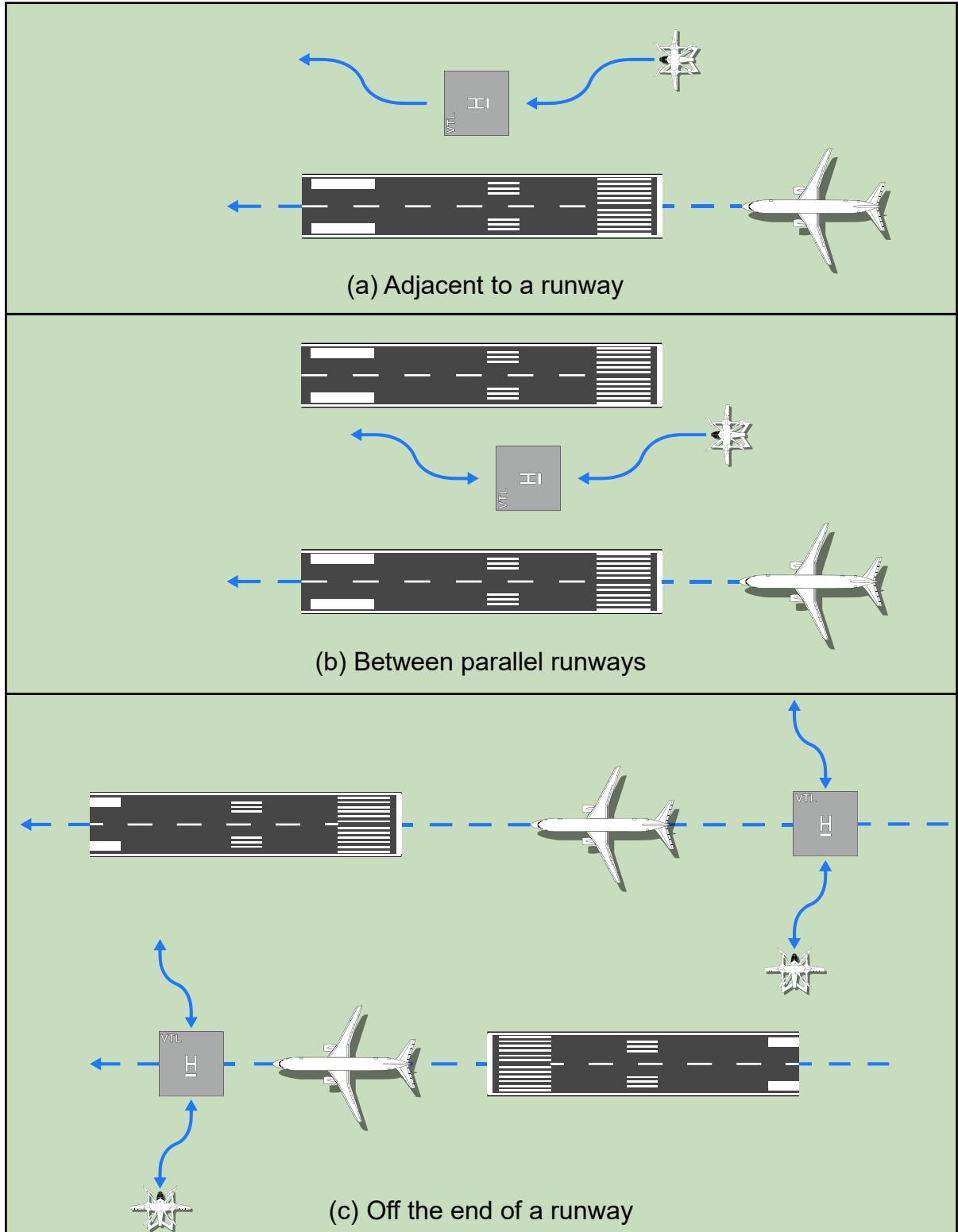
Note: These notional depictions are not to scale and only illustrate the relative position of a vertiport in relation to a runway. The actual distances from the runway are critical to assessing the potential impacts.
Vertiport proponents should also be aware that VTOL aircraft crossing an active runway may be delayed by ATC until there is a sufficient gap between runway operations. As such, VTOL aircraft to/from destinations that are located on the other side of a runway at a busy airport may experience additional delays and/or circuitous routings.
Another important consideration is the vertiport location relative to the visual traffic pattern. A vertiport that is located below the visual traffic pattern may experience delays as controllers sequence VTOL arrivals and departures with aircraft in the traffic pattern.
Lastly, when siting a vertiport adjacent to an airport runway, vertiport proponents should become familiar with the missed approach procedures at the airport. If a vertiport is in the path of a missed approach procedure, controllers may need to apply additional buffer between an aircraft landing at the airport and VTOL aircraft landing/departing the vertiport.
A.4.2. Vertiport Location Between Parallel Runways.
In addition to the considerations discussed in the previous section, vertiports located between parallel runways introduce additional ATC complexities that could increase delays for VTOL aircraft. With runways on both sides of the vertiport, ATC must consider multiple active flight paths, types of aircraft, and limitations.
When a VTOL aircraft arrives/departs a vertiport located between parallel runways, it must either fly over a runway or proceed parallel to the runway until it can safely cross the extended runway centerline. In some cases, the most direct route would be to fly over the runway. However, at busy airports, the efficiency impacts due to wake turbulence separation and/or missed approach procedures can create significant delays for VTOL aircraft. In other cases, arriving/departing parallel to the runways before crossing the extended runway centerline may result in less delay, but it could also increase flying time/distance.
A.4.3. Vertiport Location Off the End of Airport Runways.
Vertiports located near the approach or departure end of an airport runway may present significant challenges for ATC. Locations closer to the runway arrival threshold or departure ends will present greater difficulty than those farther away and incur more delays and/or operational restrictions.
For example, if a vertiport is placed along the extended runway centerline, vertiport aircraft must be able to enter their ingress/egress routes at an altitude at least 500 feet (152 m) below traffic arriving or departing from the runway (1,000 feet when passing underneath a heavy/super aircraft). If the vertiport is close enough to the runway and the above separation cannot be achieved, VTOL operations will need to be delayed until there is a sufficient gap in the arrival or departure sequence to the runway.
APPENDIX B. ACRONYMS AND TERMS
| AAM | advanced air mobility |
| AC | Advisory Circular |
| AC | alternating current |
| ADA | Americans with Disabilities Act |
| ALP | Airport Layout Plan |
| AWOS | automated weather observing system |
| CCS | combined charging standard |
| CD | candela |
| CFR | Code of Federal Regulations |
| D | controlling dimension |
| DC | direct current |
| DCA | downwash/outwash caution area |
| DER | distributed energy resource |
| DWOW | Downwash/Outwash |
| EB | Engineering Brief |
| EMS | Emergency Medical Service |
| ESS | energy storage system |
| ETL | effective translational lift |
| EV | electric vehicle |
| EVSE | electric vehicle supply equipment |
| eVTOL | electric vertical takeoff and landing |
| FAA | Federal Aviation Administration |
| FATO | final approach and takeoff area |
| FC | failure condition |
| FOD | foreign object debris |
| GSE | ground service equipment |
| GVGI | generic visual glideslope indicators |
| HOGE | hover out of ground eff ect |
| IEC | International Electrotechnical Commission |
| IEEE | Institute of Electrical and Electronics Engineers |
| IFC | International Fire Code |
| IFR | instrument flight rules |
| IMC | instrument meteorological conditions |
| ISO | International Organization for Standardization |
| kph | kilometers per hour |
| kWh | kilowatt per hour |
| LAP | Landing Area Proposal |
| LBA | load-bearing area |
| LED | light emitting diode |
| LOB | line of business |
| MCS | megawatt charging system |
| mJ | millijoule |
| MSL | mean sea level |
| MTOW | maximum takeoff weight |
| MW | megawatt |
| MWh | megawatt per hour |
| NAS | National Airspace System |
| NEC | National Electric Code |
| NEPA | National Environmental Policy Act |
| NEMSPA | National EMS Pilots Association |
| NFPA | National Fire Protection Association |
| NREL | National Renewable Energy Laboratory |
| OEM | original equipment manufacturer |
| OFA | object free area |
| PAPI | precision approach path indicator |
| PPR | prior permission required |
| R&D | Research and Development |
| RD | Rotor diameter |
| RNAV | Area Navigation |
| SAE | SAE International |
| TDPC | touchdown/positioning circle |
| TLOF | touchdown and liftoff area |
| UL | Underwriters Laboratories |
| VFR | visual flight rules |
VGSI Visual Glideslope Indicator VMC visual meteorological conditions VTOL vertical takeoff and landing
没有要显示的评论
没有要显示的评论